

TL;DR
My unofficial remix of Ella Langley’s “Weren’t for the Wind” puts her vocal over a 144 BPM melodic progressive trance arrangement. The full remix remains private.
A piano nod to “Froggy Went a-Courtin’” and her mom’s Depeche Mode and New Order listening connect the arrangement to her childhood.
The current master keeps those references, with a quieter place for the piano before Ella returns. The excerpt below lets you hear that passage.

Ella Langley came to mind one evening several months back while doing a listening session, thinking about what to remix next. I ended up choosing “Weren’t for the Wind.” Somewhere along the way, a childhood folk song ended up in the Ableton project.
I wanted to know more about Ella before taking her song in a completely different direction. The surprise was finding out that her mom listened to Depeche Mode and New Order. I grew up loving both, so yes, I got pretty excited about that connection. I hadn’t expected to find it while researching a country artist.
The remix is melodic progressive trance at 144 BPM. I want the movement and emotion I love in trance, with enough space for Ella to still sound like Ella. That means paying attention to where a melody enters, how long an echo lasts and which sounds actually need to play together.
Listen to Ella Langley’s original “Weren’t for the Wind” on Spotify.
The Ableton screenshots below show an earlier working version and the decisions I was making then. The listening excerpt comes from the current master.
Her mom listened to Depeche Mode and New Order
The Pollstar profile connects her dad with ‘80s hair bands and old-school country, and her mom with Pearl Jam, Depeche Mode, New Order and some Peter, Paul and Mary.
Knowing those records were part of her childhood gave me an idea for a second electronic melody that could move through the spaces between her lines. There’s an original repeating line in the project for that purpose. It doesn’t use a riff or a recording from either band.
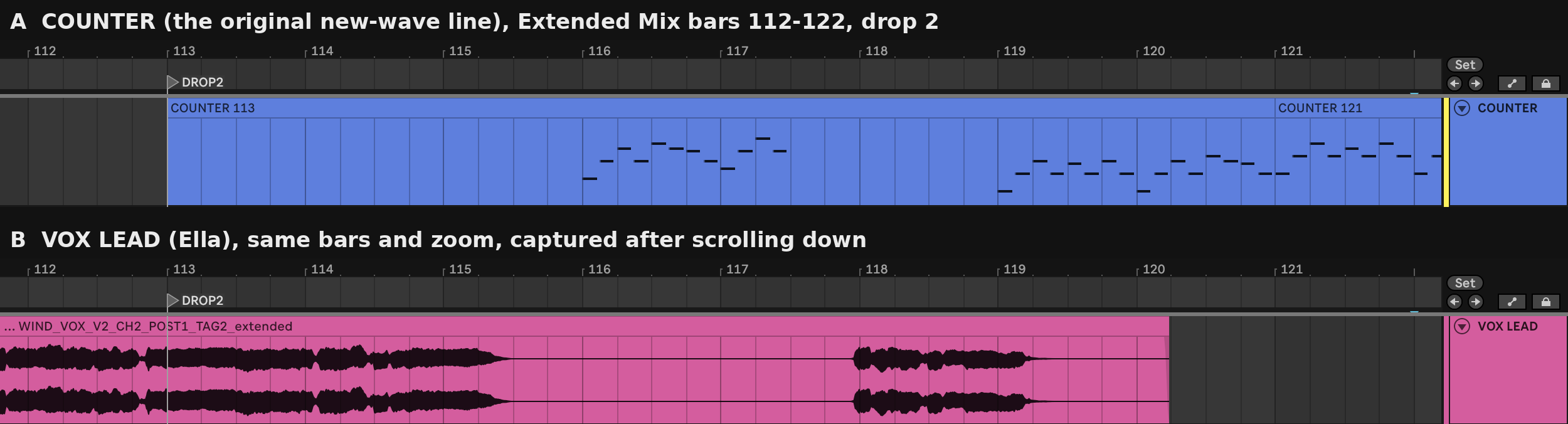
There’s a slightly awkward part to this, though. I love those bands, and I really didn’t like some of the original synth sounds I used in my remix. My note about two of the leads was “crappy 80s synthesizers.” That’s how they sounded to me. I needed sounds that worked better with her vocal and the trance arrangement.
I don’t want an ‘80s throwback. I’m making a ZenOne trance remix now, with sounds that change as the track develops. The family connection gave me an idea for a musical part. I didn’t want it to push me toward a particular synth sound.
One lead, which I called LEADF in the session, was closer to what I wanted. I soloed tracks to hear it without LEAD and LEAD2 piled on top. An earlier revision kept LEADF as the main part and added a lighter layer at the climax. LEAD and LEAD2 sounded much better to me after later changes. The current arrangement gives those parts different places to play, including instrumental sections where Ella’s voice drops out.
If you’re sorting out a similar problem, keep the vocal playing while you compare the leads. Start with one, then bring the others back individually. Listen for what each adds: a different melody, a higher octave or simply more of the same sound. Match the overall listening level as closely as you can, because the louder combination can seem better just because it’s louder.
Then check a complete phrase. A lead can sound great in the gap after a lyric and become distracting when the singer returns. Shortening that part or moving its notes to a different octave may help more than another effect. I’ll still use filters and effects for movement, but I want to choose which parts play together first.
Froggy is already in there
In her Rolling Stone interview, Ella talked about learning “Froggy Went a-Courtin’” as a child and singing it with her family at reunions. Her album Dandelion opens and closes with excerpts of a performance she recorded with Charlie Worsham.
That made this a much more personal reference than picking a sound that I associate with country music. There’s a little piano version of a phrase from the tune in the breakdown, the section where the drums pull back. A shorter version is in the Radio Edit, too. It’s a new piano part, not a sample from her album.
Listen: one minute from my current extended master. The Froggy piano opens the excerpt, then Ella returns over the developing trance arrangement.
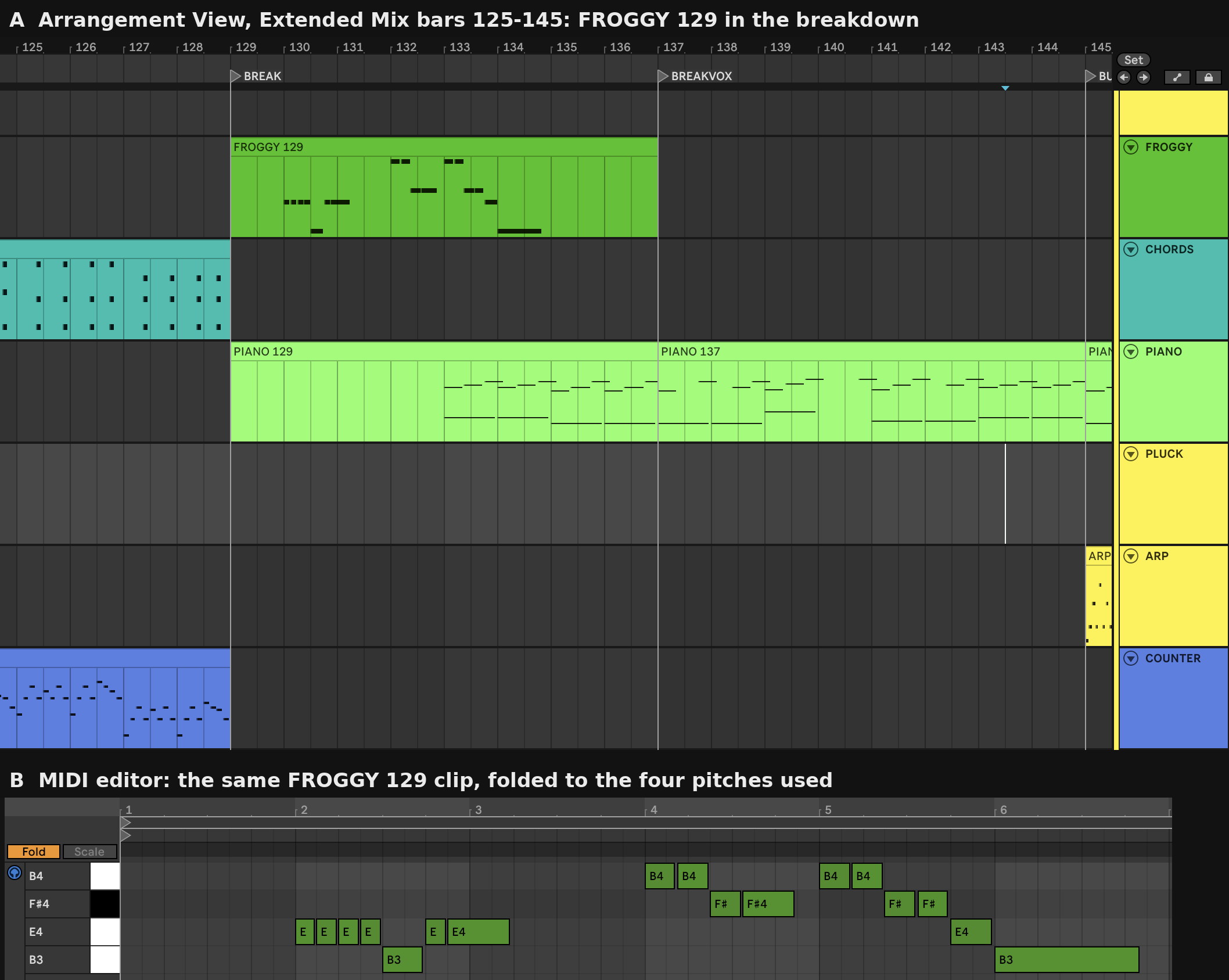
I kept checking the phrase against her recording by ear. Having the notes in the project doesn’t tell me how closely they match the version she sings, or whether she’d immediately recognize it.
For another producer trying a familiar melody, I’d check the notes against the chords underneath it, not just the key listed for the song. A note can belong to that key and still clash with the chord playing at that moment. Hold the note against the chord and listen. You may want that tension, or you may want to move the phrase to a different chord.
The timing matters, too. Put the piano under an important vocal line and the listener has two melodies to follow. Here, it has a quieter section of its own. The first test is whether the piano works there. How much someone notices the reference comes after that.
I would love for Ella to hear it and recognize the connection. But I also want someone who knows nothing about her family or that tune to enjoy the piano when it arrives.
The wind shouldn’t be annoying
I wanted wind that feels like a beautiful Tennessee day. The WIND track in my Ableton project was getting better, but I could still hear what I described as “audio flips.” Those interruptions kept pulling my attention away from the song.
An earlier round traced the wind problem to rapid volume flutter and a gap between clips. The volume changes were smoothed, and a soft wind-through-trees recording was added. At the stage shown below, two wind recordings supplied the gusts and a quieter wind-through-leaves layer. A separate cicada track I was initially testing was intentionally muted.
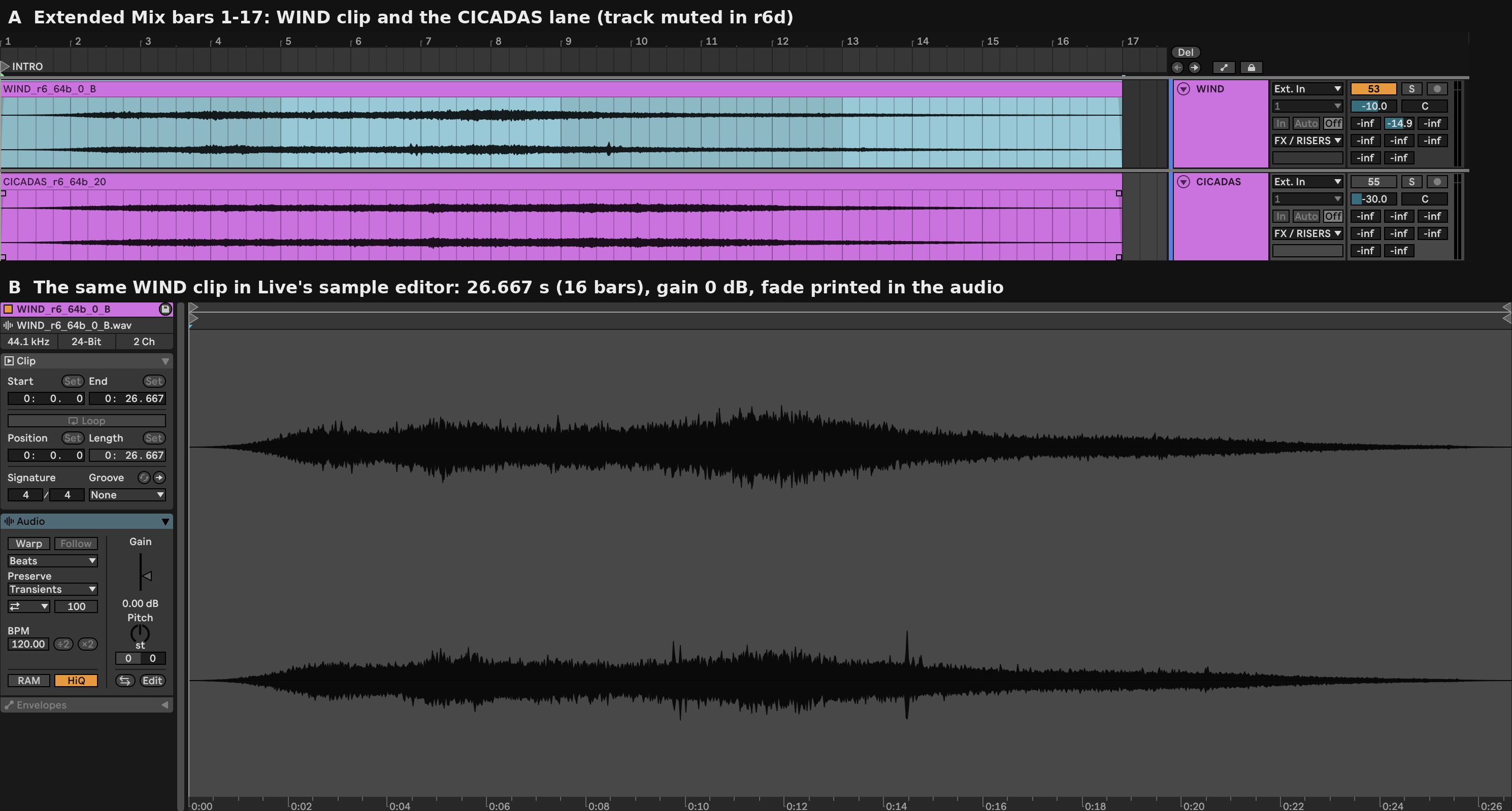
For this kind of background sound, I’d check the edit before reaching for another effect. Listen across the join between clips, first on its own and then with the music. A short fade can soften a hard edge. If both clips overlap, listen for a swell where the two recordings add together. A clean join on screen still needs a listening check.
The current arrangement still gives the opening wind 16 bars.
The shaker had been distracting me, too. In the working version shown below, it sits slightly right of center without moving from side to side. Its hits alternate between softer and louder. Each hit is a separate audio clip, so the accents come from clip gain rather than MIDI velocity.
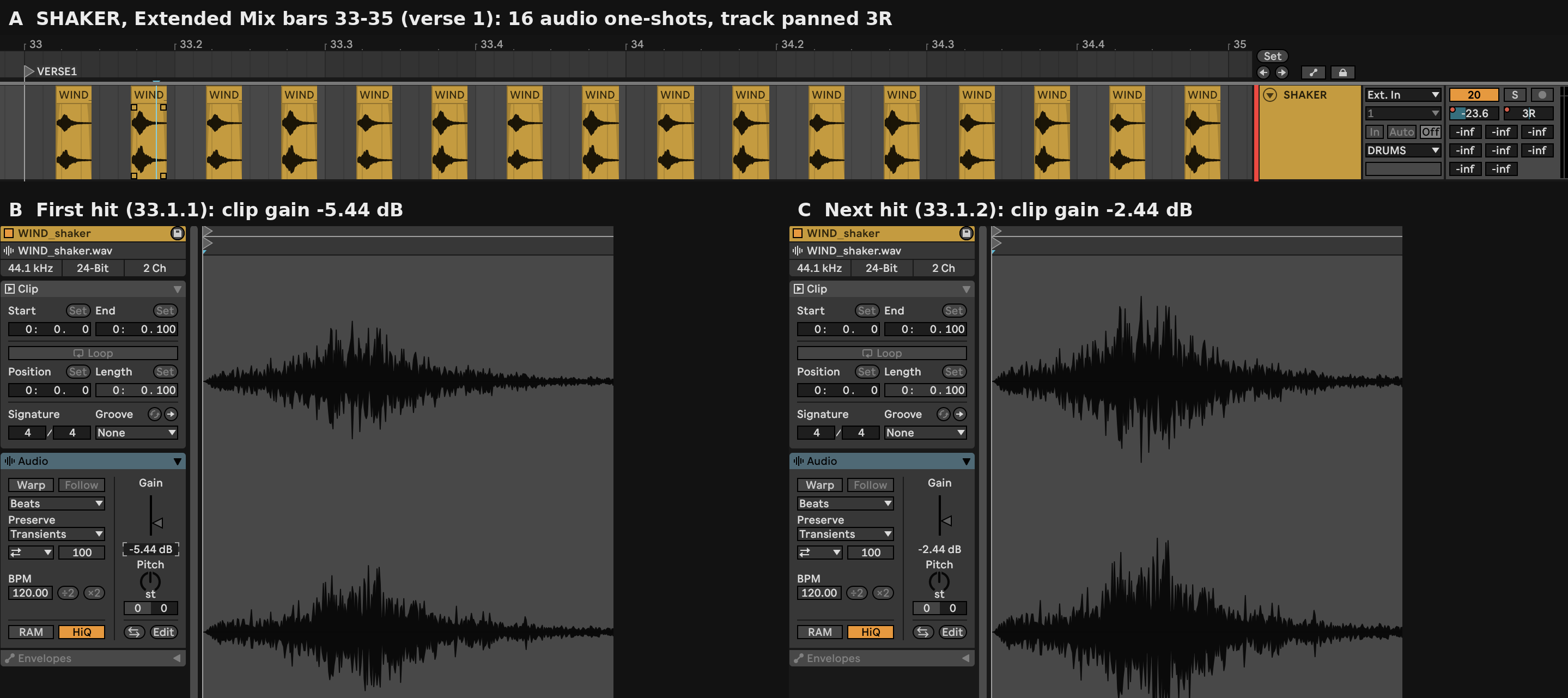
I’d start that check with the shaker lower in the full mix, then listen to whether individual hits stick out. For MIDI, changing velocity can vary the force or tone of a hit, depending on how the instrument responds. With recorded audio, adjust the clip gain or volume envelope instead. Panning is a separate choice. I’ve learned that more movement can make a distracting shaker even harder to ignore.
Leave room after the words
I want some space and movement around Ella’s voice, but I want to hear what she’s saying. An earlier revision added ambience that lowers itself while she’s singing, along with echoes after selected words.
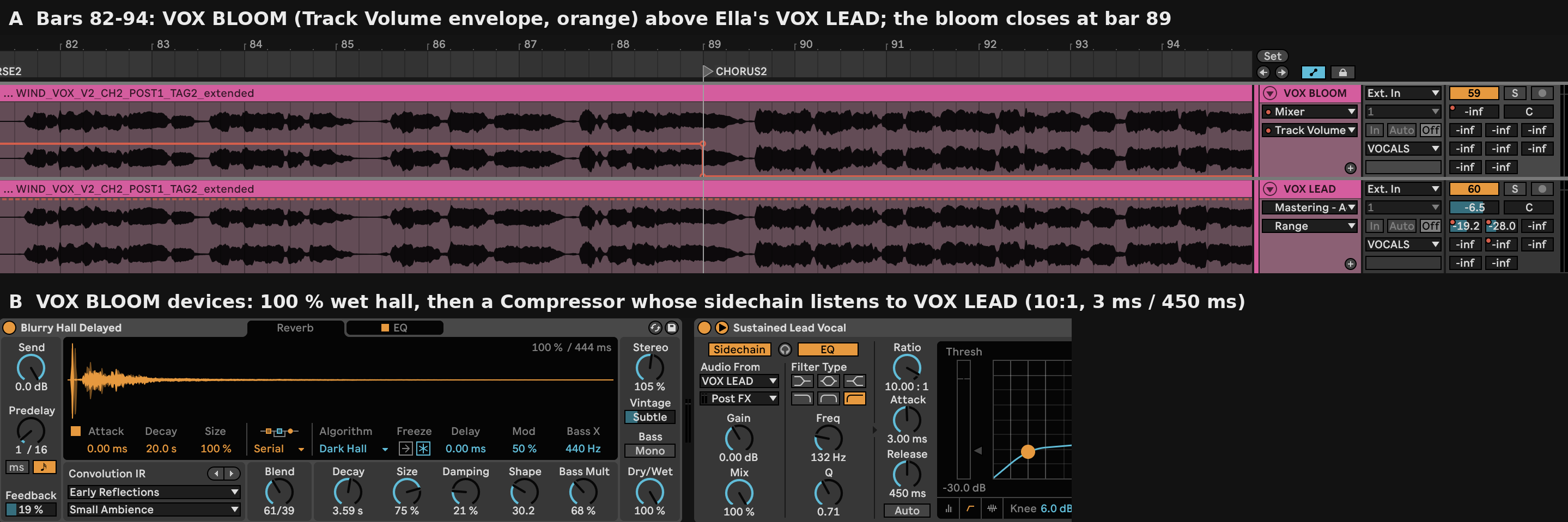
VOX BLOOM is a separate audio track carrying a copy of Ella’s vocal through reverb. A compressor uses the lead vocal as its sidechain input, the signal that tells it when to turn the reverb down. That temporary reduction is called ducking. In this earlier working view, separate volume automation switches the effect off at bar 89.
I’d check the reverb and delay over the end of one line and the beginning of the next. A long echo can sound lovely after the first line, then repeat over the next word. Shorten it or lower it there if it makes the lyric harder to follow. For a delay throw, an echo added to a chosen word or phrase, listen to the whole word rather than judging the tail alone.
You don’t need the same amount of effect on every line. A longer pause might leave room for an echo that would be too much in the next verse. Those gaps need their own choices rather than one effect setting running through the whole song.
I explored a different vocal problem in my Forest Blakk “Long Story Short” article: how moving phrases changed the arrangement. Here, I’m looking at what happens around Ella’s words, including the melodies and effects that might distract from them.
I want to hear it before explaining it
I’m excited about these connections. That also makes it easy to get attached to a part because I like why it’s there.
For the piano reference, I want to compare the same passage with and without it, at a similar listening level. I’d play both before mentioning Froggy and ask what the listener noticed. Then I’d explain the connection and play it again. I’m curious whether knowing the story adds something, or whether I was relying on the story to make them like the part.
On my Patient Zero remix, I took out a fiddle part even though I liked its nod to 13. With Froggy, I’d prefer to hear what listeners make of the part before I explain why I put it there.
I do want Ella to hear the remix. Of course I do. The full version remains private while I seek permission to share it. This is an unofficial ZenOne remix, not an endorsed Ella Langley release.
Froggy stays in the current master. I haven’t run that listener comparison, so I can’t say whether the reference changes how people hear the passage. You can hear the piano here before deciding whether the story adds anything.
Resources
Ella Langley, “Weren’t for the Wind” on Spotify: the original recording.
Pollstar’s January 30 profile: her mom’s Depeche Mode and New Order listening, alongside her dad’s different musical tastes.
Rolling Stone’s April 8 interview: the family-piano connection and Froggy performances on Dandelion.
Ableton Live 11 manual: audio clip fades: fade handles and crossfades in Arrangement View.
Ableton Live 11 manual: audio effects: Compressor sidechain controls and delay behavior.