

TL;DR
I rebuilt Forest Blakk’s “Long Story Short” using only his vocal from the original recording.
In the first version, I moved vocal phrases to fit my arrangement. Some edits changed how the performance felt to me.
Next, I’ll keep the original phrase order and spacing, then build the music around them. This is an unofficial reimagining, not an official Forest Blakk remix or release. Forest’s team reviewed the article and gave me permission to make the track public on SoundCloud.
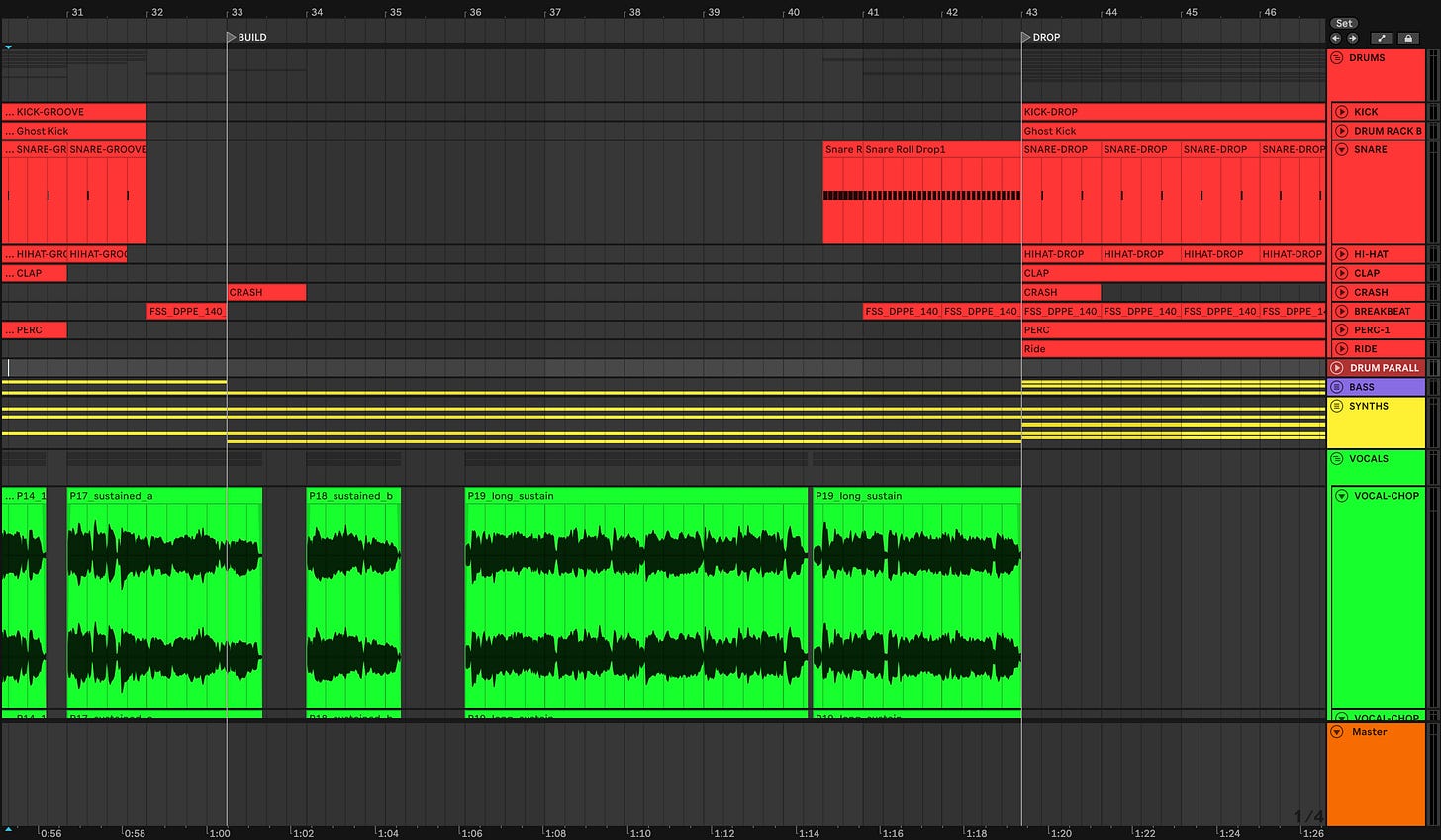
Bars 31 to 46 of the first version in Ableton Live. The build starts at bar 33 and the drop lands at bar 43. Forest’s phrase is the long green clip that starts at bar 36 and ends right on the drop line. An eight-bar build would have ended at bar 41, with the phrase still going. The snare roll underneath starts halfway through bar 40.
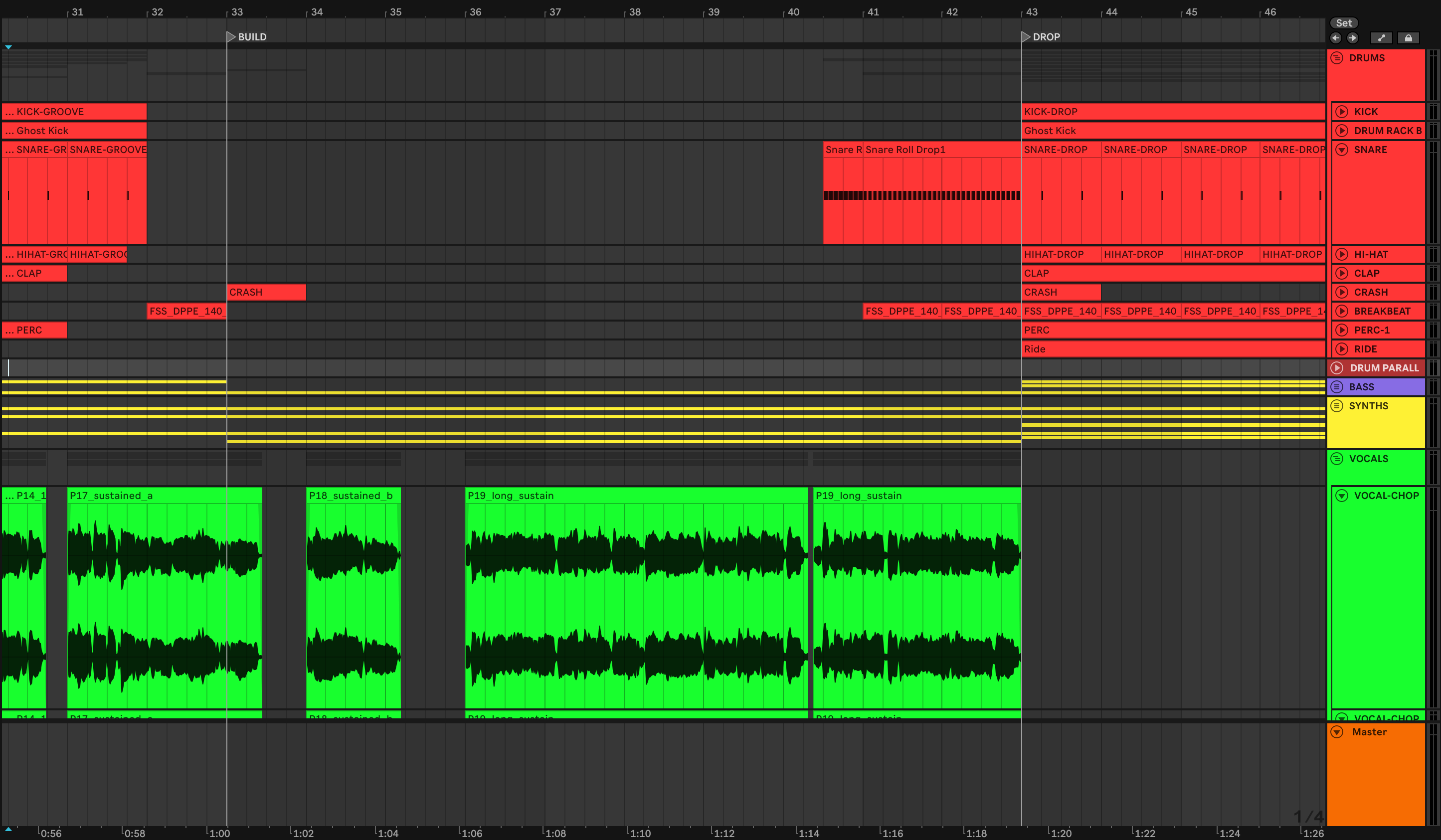
I’d planned an eight-bar build, where the music gathers tension before the drop. Forest’s vocal phrase ran past it. In Ableton Live 11, I could’ve trimmed the phrase or moved part of it to make the drop arrive where I’d planned.
Instead, I extended the build to ten bars so Forest could finish the phrase as his delivery grew more intense.
This is an unofficial reimagining of Forest Blakk’s “Long Story Short,” not an official Forest Blakk remix or release. Forest’s team initially declined release clearance, but after reviewing this article they gave me permission to make the track public on SoundCloud. René Renner, COO of Logan Media Entertainment, specifically asked that I make clear this is not an official remix.
I started with one rule: keep the voice
My wife introduced me to “Long Story Short,” and we both connected with it. I wanted to keep Forest’s vocal and write a new melodic, progressive electronic arrangement around it.
His vocal was the only audio I carried over from the original recording. I built the drums, bass and chord parts myself.
But I’d left myself one freedom: I could move the vocal phrases.
I cut phrases, rearranged sections and reused vocal fragments. I still wanted the lyrics to make emotional sense, but I could change when a line arrived or how long the gap before it lasted to fit my arrangement.
That gave me room to build the track. But it left me wondering how much I was changing the feeling of the performance by changing its pauses and timing.
The phrase that broke the eight-bar habit
The ten-bar build was one place where I’d already let the vocal change my plan. Cutting the phrase at the eight-bar mark felt abrupt, so I delayed the drop and let the phrase finish.
As the snare roll built toward the drop, it became harder to hear the vocal clearly. The phrase had enough time now, but it needed more room in the mix.
I automated the vocal volume to rise through the build so it stayed audible as the snare roll intensified. At the drop, I brought the vocal level back down.
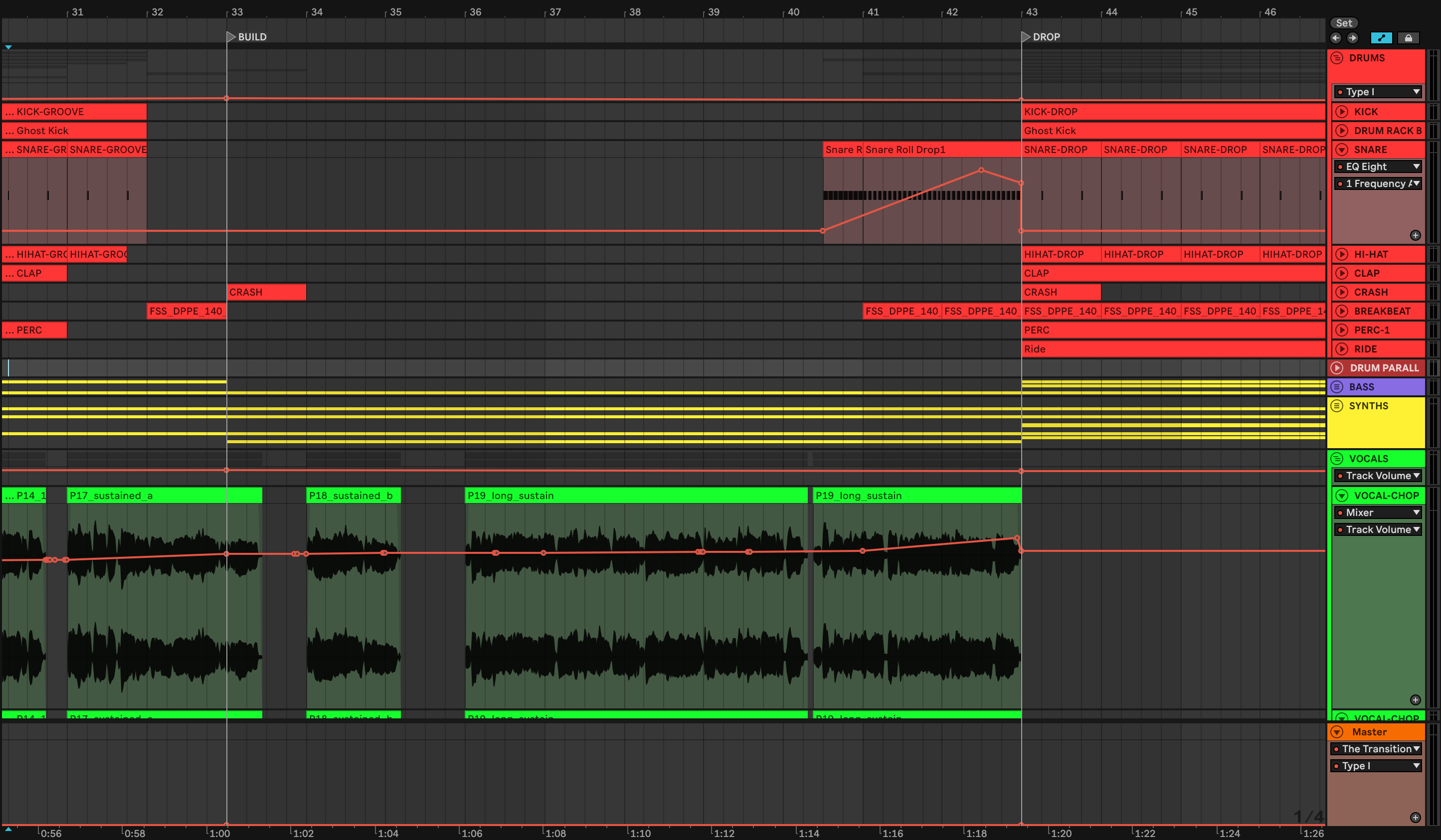
Here, the volume automation kept attention on the vocal as the build got busier.
I also added delay throws: echoes on selected phrase endings. They filled the gaps without leaving echoes running over the next vocal line.
The vocal was now shaping both the section length and how I balanced the build around it.
The vocal contains more than lyrics
I used the vocal melody to guide the new chords and instrumental parts. I built my arrangement in A major, with F-sharp minor, D, A and E chords through the verses. In the drops, I used A, E, F-sharp minor and D, with a D-to-E chord change leading into the main drop.
In the second drop, the lead instrument plays Forest’s chorus melody two octaves above the vocal. Another lead later adds a harmony a third above it, using notes from A major. I wrote new instrumental parts around the melody already present in his singing.
I also changed the pitch range of an arpeggiated part, a repeating pattern that plays chord notes one at a time. I moved it higher for a brighter sound and lower where that helped the vocal stay clear. In the bigger drop, I changed its range again to make room for the lead melody.
Sometimes changing the notes’ pitch range separates two parts more clearly than adjusting their tone with EQ.
Next, I’ll keep the vocal timing intact
For the next version, I’ll use the same vocal source and build all the instrumental parts again. This time, I’ll keep the phrases in their original order and preserve the pauses between them. I’ll decide where sections begin and end around that performance.
That might mean a seven-bar section instead of eight, or a transition later than I’d usually place it. I may leave a pause open where I’d normally add a fill. The section lengths will follow the vocal rather than my usual pattern.
I haven’t made the second version yet, so I don’t know how it’ll compare.
I expect keeping the original pauses and phrase lengths to preserve more of the feeling I heard in Forest’s performance. I also expect it to be harder to build a steady electronic groove around it. Repeated patterns and familiar section lengths help establish when a change feels due. I want to hear what happens when the vocal sets that timing.
I want to compare how the vocal feels and how the track moves in each version. Keeping the original timing won’t automatically make the better track.
Try both approaches with a vocal you have permission to edit
Start with a vocal you recorded yourself or have permission to edit. Make two copies of the same starting session.
In version A, set the section lengths and major transitions first. Then move vocal phrases or shorten the gaps between them to fit.
In version B, keep the vocal phrases in their original order with the original gaps between them. Build the drums, chords and transitions around that timing.
Then listen to both without looking at the session timeline. Does a transition cut off a phrase before it feels finished? Do the pauses help, or does the track lose momentum? Listen for drum fills that make a line harder to follow, and whether the unusual section lengths sound unusual when you can’t see the bar numbers.
You may prefer the version with regular section lengths. I might too. That’s why I want to try both.
In the first version, I could rearrange a lot of the vocal and still feel connected to the performance. But the phrase in that build felt cut short until I gave it two more bars.
Next, I’ll leave the vocal timing intact and see what I have to change around it.
In your own session, what would you have to change if you couldn’t move a vocal phrase or shorten a pause?
Resources
Forest Blakk, “Long Story Short” on Spotify, official recording reference.
ZenOne, “Long Story Short” unofficial reimagining on SoundCloud - public SoundCloud track shared with permission from Forest Blakk’s team. Not an official Forest Blakk remix or release.