

TL;DR
My 132 BPM remix of Neon Moon now uses Kacey Musgraves’ lead and the Brooks & Dunn backing vocal from Reboot. An earlier version also used Ronnie’s 1991 lead, but I removed it.
I cut some sung passages and left more room for the instrumental arrangement. The singers don’t need to fill every section.
Try replacing one repeated sung passage with an instrumental section of the same length. Listen through the next vocal entrance, not just the gap.

I started this remix by bringing two recordings of Neon Moon together. Kacey Musgraves carried the lead from the 2019 Reboot version. Ronnie Dunn’s vocal from the 1991 recording took over for part of a verse and joined her elsewhere. I didn’t keep that version.
The current arrangement uses the Reboot vocals. Kacey leads, with the Brooks & Dunn backing vocal brought forward in selected passages. Ronnie’s older lead is gone, along with the pitch shift I’d used to make it fit. I also removed some of Kacey’s sung material so the instrumental parts had more time on their own.
Brooks & Dunn are due to receive the CMA Willie Nelson Lifetime Achievement Award on November 18. This is my unofficial remix, not a collaboration with or endorsement from the artists.
I changed which Ronnie vocal I was using
In the earlier version, I shifted Ronnie’s 1991 lead down six semitones, or half an octave, to fit the key of the Reboot vocal. That gave me a second lead performance to arrange around Kacey. It also meant processing a voice quite heavily before deciding whether it belonged in the track.
I later removed that recording and used the backing vocal already present in Reboot. Kacey kept the lead instead of handing the second verse to the older Ronnie recording. The separate Brooks & Dunn vocal part now appears in the second chorus and selected passages near the end.
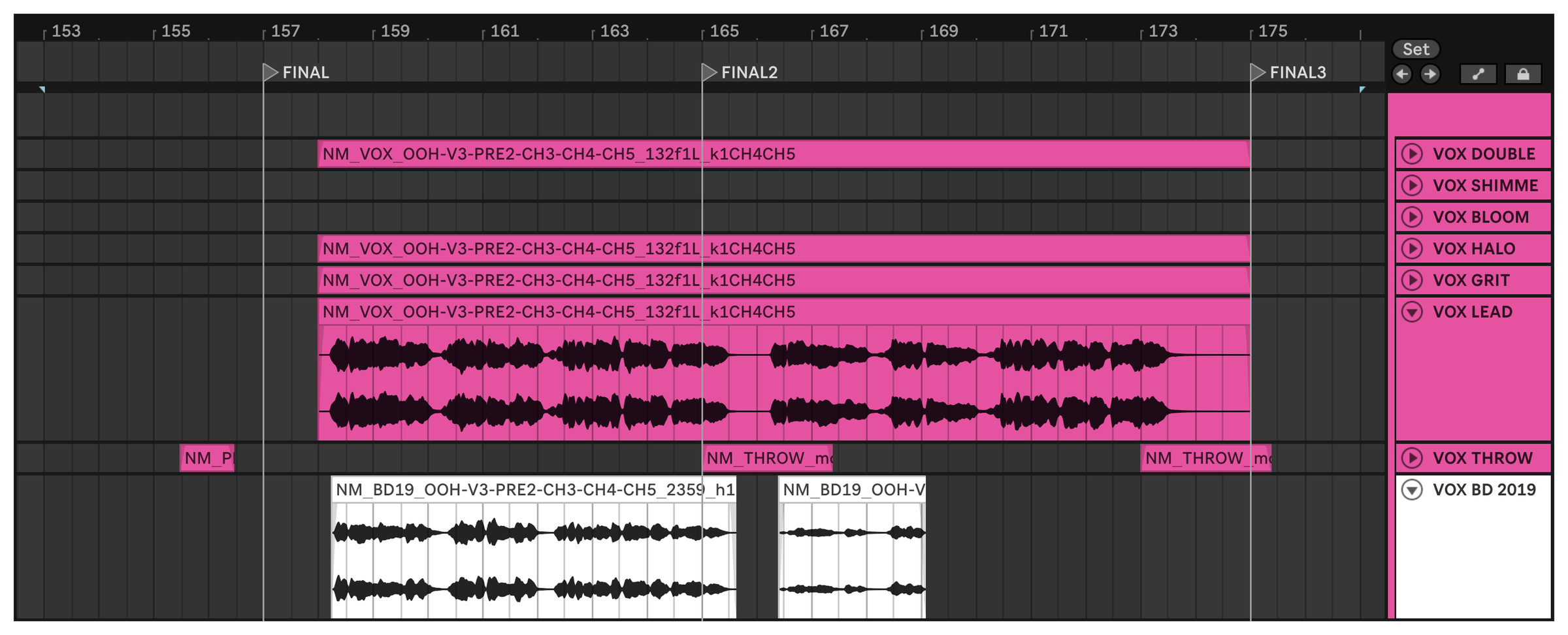
In my Jolene remix, I arranged two separately recorded leads to trade lines. “Answers” means something different here: I’m choosing when to bring the Reboot backing voice forward underneath Kacey and when to leave her on her own. Sometimes the answer is a harmony under the same line.
The Reboot arrangement already gives Kacey the lead with Brooks & Dunn behind her. Taste of Country’s 2019 write-up describes that relationship. I’m working with those recorded performances in a new electronic arrangement. I didn’t invented their pairing.
Less singing, more room around it
I removed the latter half of the second verse, two repeated wordless vocal sections and a pre-chorus and chorus later in the arrangement.
Those cuts leave different kinds of space. Part of the second verse becomes instrumental. The breakdown has fewer repeated vocal phrases. Before the final vocal drop, twelve bars of the instrumental build take the place of another pre-chorus and chorus.
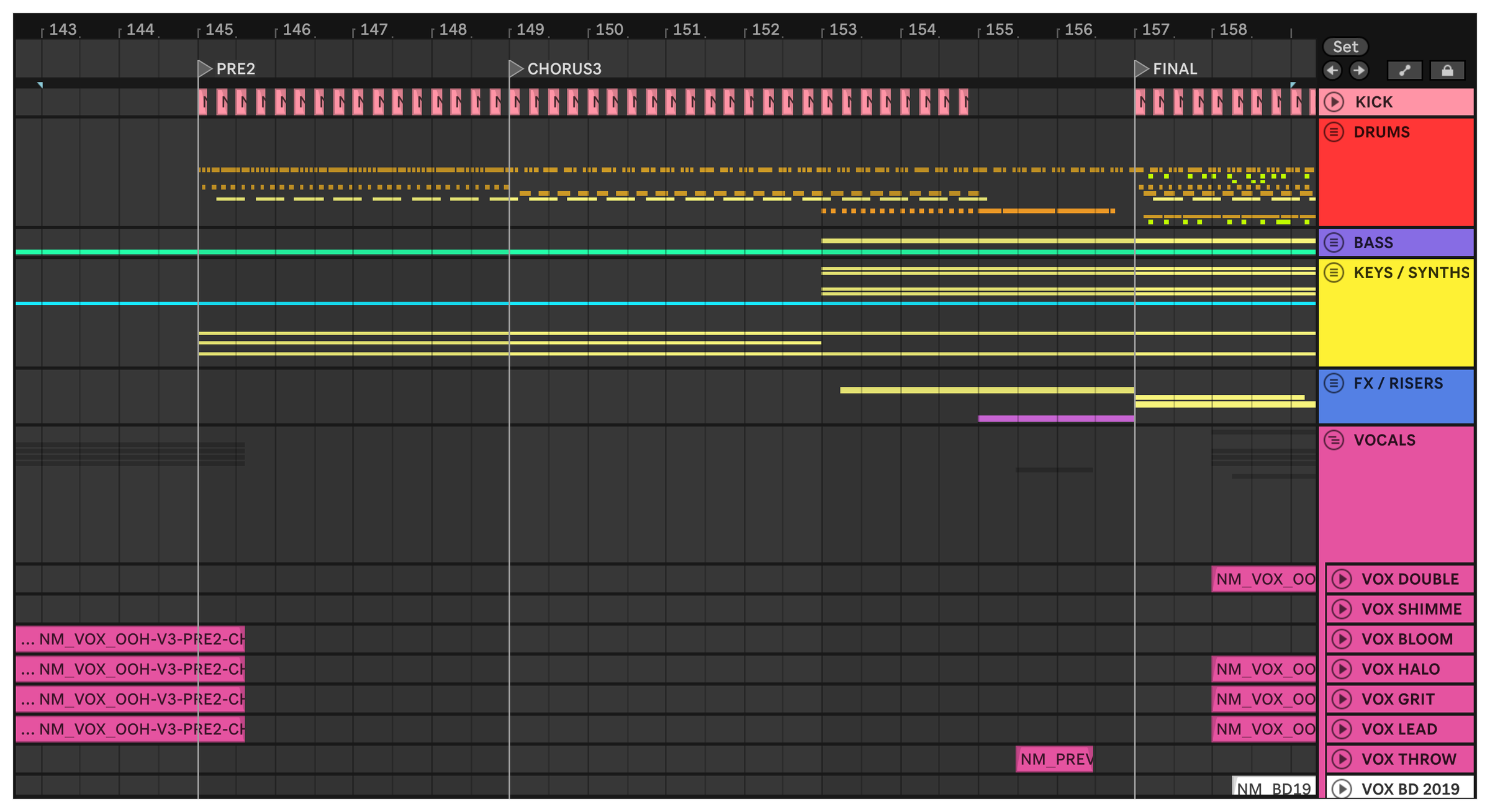
I still want the song to carry its story. I also want the synths, bass and percussion to do something beyond playing behind a vocal from start to finish. Removing a passage gives me room to develop those parts without asking the listener to follow new words at the same time.
In my Forest Blakk arrangement article, I kept a vocal phrase intact and extended the build around it. Here, I removed whole passages. I’m making a different decision about where the singing belongs, rather than using one rule for every remix.
A passage from my Neon Moon remix. Listen for the backing vocal beneath Kacey, then the change as the next instrumental drop arrives.
Two timing checks that solve different problems
The Reboot recording is about 103 beats per minute. My remix runs at 132 BPM, so the vocals have to play faster while retaining their pitch. That process is called time-stretching.
A singer doesn’t deliver every phrase at a perfectly constant pace. Kacey’s final chorus eases back toward the ending. Speeding up the whole passage by one fixed amount preserves that slowdown, which can leave the later words behind a steady electronic beat.
The production work used a changing stretch rate through that passage. Different parts were sped up by slightly different amounts to keep the later words in place without cutting every word into a separate piece.
I needed to make sure the processed vocals were placed correctly in Ableton. An early version landed about 0.886 seconds late, nearly two beats at 132 BPM. That was a file-placement error, separate from the timing inside the phrase. Moving the file back corrected where the performance began.
This concept is useful when a vocal feels late. I’d check where the first sung word lands, then listen farther into the phrase. If the first word is right and later words drift, moving the whole clip won’t fix both ends. If the whole phrase is late by the same amount, stretching it again may create a new problem that wasn’t there.
Keeping the steel without filling every gap
The recorded pedal-steel phrases come from Apple Loops, retuned and placed separately from the source vocal. They aren’t the instrumental track from Reboot.
The current saved arrangement has steel phrases in the intro, around the second drop, in the breakdown and in the outro. There’s also a reversed steel swell leading into the final vocal section. Reversing a decaying sound makes it rise toward the entrance.
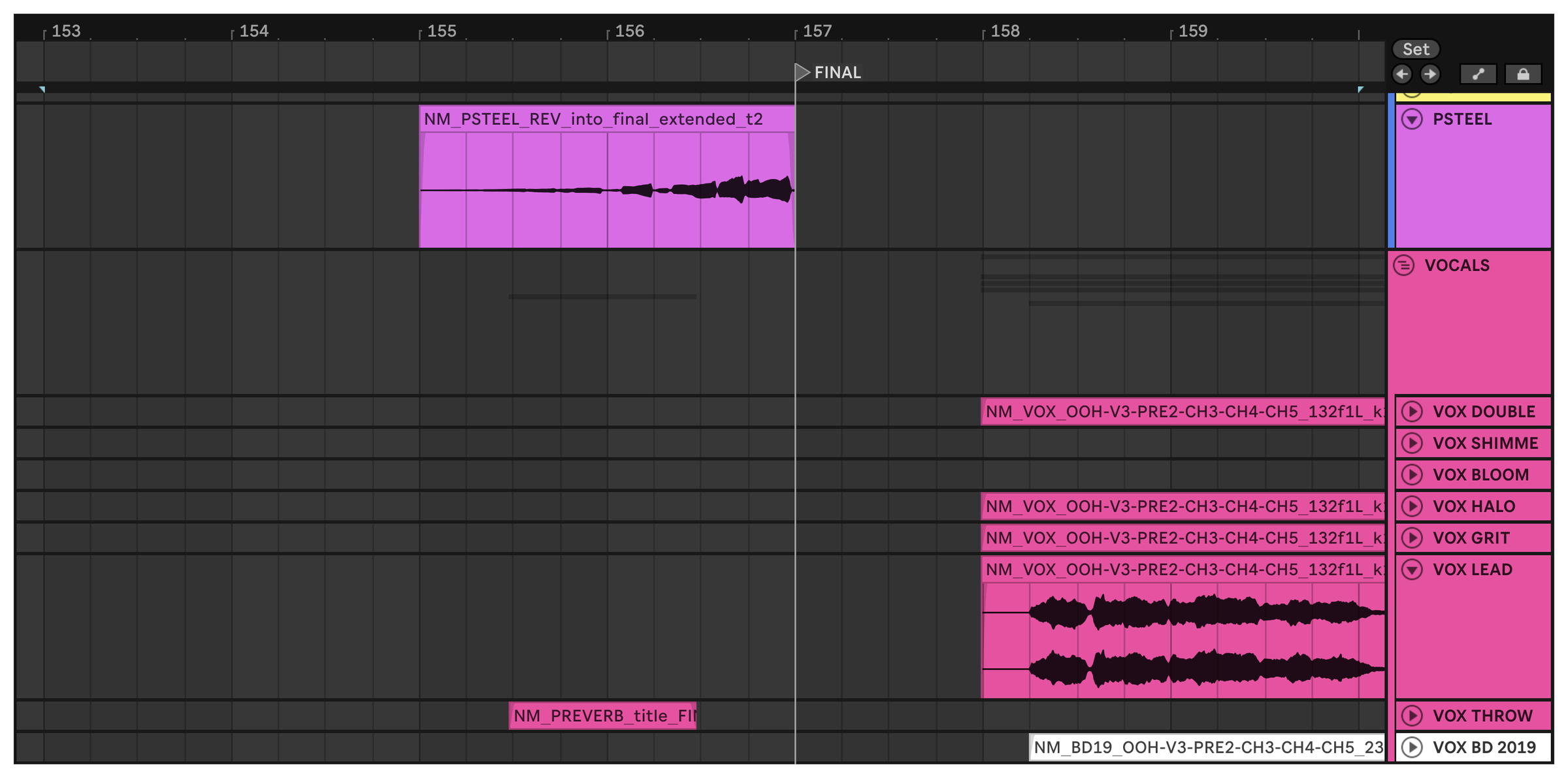
I kept the steel alongside electronic synths and rolling bass. It can answer a vocal phrase or help connect two sections without playing continuously. The newer intro and outro also develop the synth melody, with simpler notes in the first and last sixteen bars so those sections remain useful for DJ mixing.
Try leaving one repeat unsung
You can try this with your own vocal recordings or material. Choose a repeated sung passage. Make one version that keeps it and another that mutes both the lead and backing vocals there. Keep the instrumental parts and the section’s length the same.
Leave the playback volume fixed while you compare. Don’t turn up the instrumental version to compensate for the missing voice. You’re checking what the arrangement does when the singing stops.
Listen from the section before the cut through the next vocal entrance. Can you still follow the song’s story? Do the instruments develop enough to hold that stretch, or does it sound like something’s missing? The next vocal entrance matters too: removing the repeat changes how long you’ve been waiting to hear the singer again.
If the instrumental passage doesn’t hold your attention, try a shorter gap or restore the vocal. Keeping every repeat and removing every repeat aren’t the only choices.
Written by Ronnie Dunn. Vocal source: the 2019 Reboot recording of Neon Moon by Brooks & Dunn with Kacey Musgraves.
Remix production, arrangement and mastering: ZenOne. This is an unofficial remix. No artist endorsement or release clearance is implied.
Resources
CMA’s announcement of the Brooks & Dunn lifetime achievement tribute.
Taste of Country’s account of the Reboot version, including Kacey’s lead and Brooks & Dunn’s backing harmonies.
I Moved the Vocal to Fit the Track. One Phrase Changed the Plan., my earlier Forest Blakk arrangement article.