

TL;DR
A friend sent me a track he said an AI system made in 49 seconds. I hope it gets him making music again. I want a different kind of help in my own studio.
Music-learning studies report both skill benefits and dependence. They don’t prove that AI caused either.
I use AI to help me understand problems, then I make the changes and listen for myself.
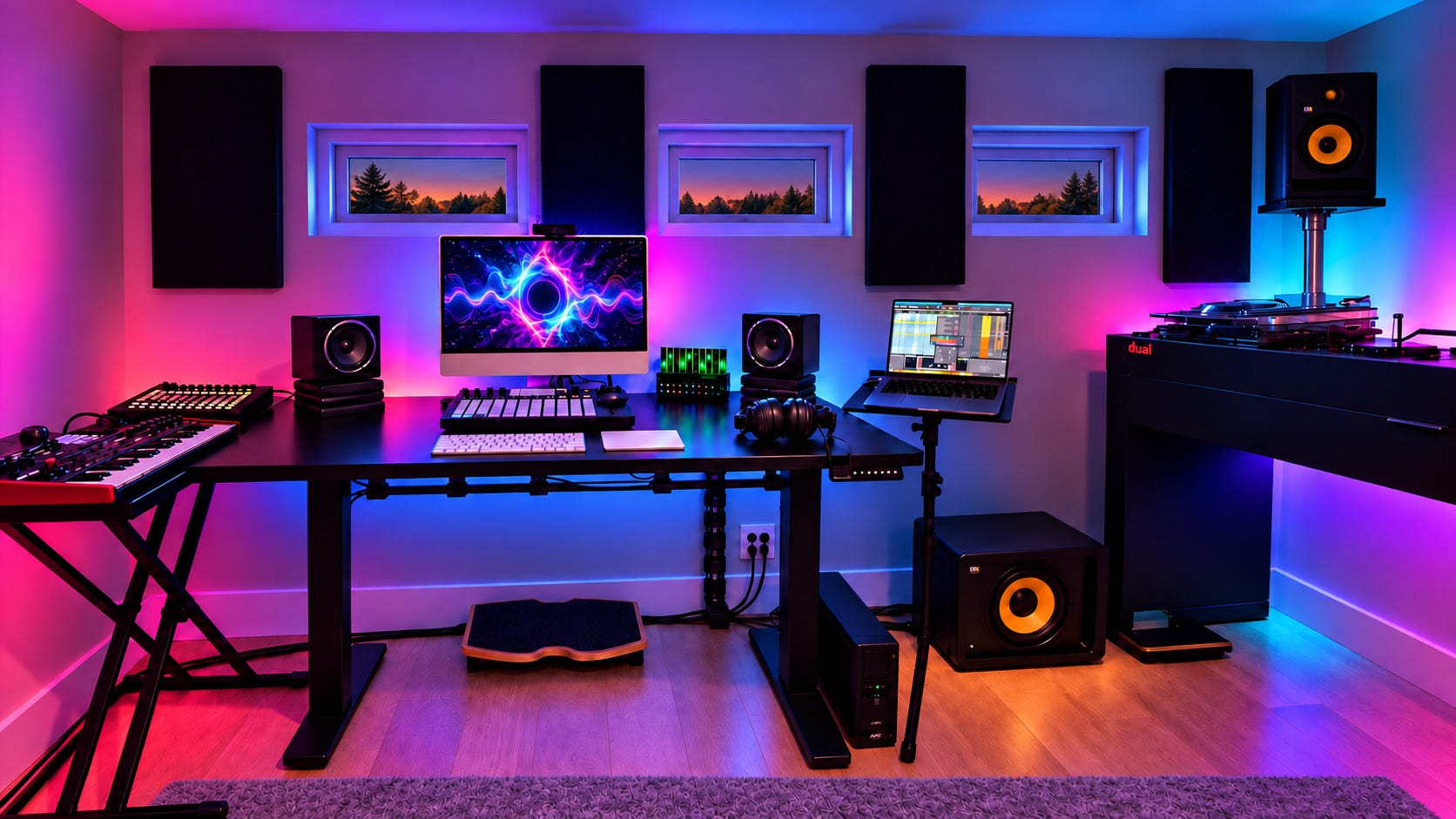
A friend sent me a complete track he said a text-to-song system made in 49 seconds. My first reaction was basically: that’s insane. I also really hope it gets him making music again.
I’m all-in on AI as a technology. I use it constantly in my daily life. But I don’t want it to make my songs for me. I like writing the arrangement, choosing sounds and figuring out why something I thought would work doesn’t. Getting better at that is part of why I make music.
Where I use it
Most of my AI use around music comes after I’ve made something. I’m still in Ableton moving notes, creating sounds and deciding which parts to keep. Then I export the audio and check it with music production software I’ve written. That software measures the audio, and I use AI to help me investigate what the results might mean. I compare that with what I actually hear.
Those tools can give me a place to start listening. Two instruments may be covering each other up. The bass may be hiding the first hit of the kick. A note may need a closer check. I still have to hear the suspected problem in the track and decide whether to change anything.
In The AI That Can’t Hear You, I wrote about the limits of meters and automated advice. Here I’m interested in what I can learn from checking that advice. If I hear the problem, try a change and compare the result, I have something to recognize next time. If I just follow the instructions, I may finish with a better mix and still need the same instructions on the next one.
You can learn this without AI, of course. A compressor setting that takes too much punch out of the drums gives you something to hear and correct. So does a bass that sounds huge on its own but disappears when the kick comes back. I want help understanding what happened, and I want to hear whether the fix worked.
The help I can keep asking for
I think about coding in much the same way. I’ve written code for most of my life, and a lot of my music tooling is something I built myself. I use applications and command-line tools on Linux and macOS, with Python often connecting the pieces.
I’m happy to let AI take a first pass at routine code, help me remember how to use a software library or work through a bug with me. I still decide what I’m building and check whether the code does what I intended. Somewhat unexpectedly, I think it’s made me a better programmer. I get through the mundane parts faster and have more time to understand approaches I might not have tried on my own.
I never quite got that from pair programming or asking colleagues for help. People are busy. Sometimes there’s an expectation that you should already know the answer. Sometimes it’s just gatekeeping.
I’ve run into that in music too. Some producers have been incredibly generous with their time and knowledge. With others, I came away feeling they didn’t want to explain what they knew. It’s frustrating when you’re trying to learn and can’t get past “just do it this way.”
With AI, I can ask a basic question, admit I still don’t get it and ask it another way. I can try the suggestion and come back with what happened. I don’t have to worry about looking stupid or wearing out someone’s patience. I still have to check the answer, but I can keep working through the problem while it’s in front of me.
Artists who can afford engineers, producers or session musicians have people to ask when something isn’t working. As an independent artist, I’m building tools that help me inspect audio, work through code and understand production techniques I want to try.
AI can give me a convincing explanation that’s wrong. And if it hasn’t received the audio, it’s working from my description of what I hear. I still value having an experienced engineer listen to a session. But being able to ask questions whenever I’m stuck, and keep asking until I understand, has made a difference in how I work.
I’ve heard this before
Honestly, I’m tired of the blanket AI hate. I heard the same rhetoric when the Internet took off, then again with ecommerce. I’ve seen enough of these changes to want to try the tools before deciding what they’re worth.
There are plenty of things worth questioning about AI. I question its answers all the time. But dismissing the whole thing means passing up the chance to find out where it could help you. I think some people are limiting themselves that way. They may eventually find themselves trying to catch up. I don’t want to be in that situation.
In my own work, I can ask more questions, try more approaches and get help with things I used to stay stuck on. That’s been useful to me. Whether it helps people learn is a separate question, and the research deserves a closer look.
A 2026 study in Acta Psychologica surveyed 1,142 music students at six university music schools in China and interviewed 15 experts. More generative-AI use was linked with stronger music skills and greater dependence on AI. Among students who better understood how to use and assess AI, the link with skills was stronger and the link with dependence was weaker.
The survey captured one point in time, so it couldn’t establish whether AI caused those differences. What interested me was the difference associated with knowing how to use and question the tools.
A separate conservatory study followed 512 students across a 16-week semester. Students reporting more AI-assisted practice later reported doing more to plan, check and adjust their practice. Those habits were associated with better instructor-rated performance. The relationship also went the other way: students already managing their practice more actively tended to report more AI-assisted practice later. The study couldn’t establish that AI caused the improvement.
A composition study of 355 undergraduates examined a course where students had to evaluate and revise AI-generated music. Students who found the AI support more useful also reported greater creative confidence, involvement and ownership of their work. The researchers didn’t compare that approach with simply accepting the first result or establish that more revisions meant more learning.
These studies don’t test how I work in my studio. They don’t prove that my approach works or that generating a whole song stops someone from learning. I’m interested in what I understand afterward. Can I hear the problem more clearly? Do I understand why a change helped? Can I use what I learned the next time I sit down to make music?
Making a song or helping me work on one
I don’t use Suno or similar tools to generate my music, but I’ve followed what they’re building. I’ve been fortunate to work at Netflix, Facebook and Microsoft during my security career. Music is another big part of my life, so when Suno advertised a Head of Security Engineering role earlier this year, I applied. I thought it was worth a conversation. Apparently my enthusiasm for that combination wasn’t mutual.
Suno’s v6 announcement describes generating music from a prompt as well as changing a section or lyric in existing music. Studio 2.0 adds controls for editing notes, applying effects and changing settings during a track. Moises describes its Studio as creating instrument parts and samples around music an artist has already started.
That’s what the companies say their products can do. I haven’t tested those features myself. I wrote about Suno’s editing changes in The Generator Is Becoming an Editor.
Being able to change one part without generating the whole song again interests me. But most of what I want from AI in my own studio is help understanding what I’ve made, figuring out what needs work and learning how to fix it.
Try it on one problem
In one of my recent sessions, a kick wasn’t playing long enough to give me the body I wanted. The sample was there, but its playback settings were cutting it short. Checking those controls gave me something specific to change before reaching for another effect or replacing the sound.
That’s the kind of help I want from AI. Something I can try, hear and understand.
Pick one problem in your own session. Maybe the vocal gets lost when the arrangement gets busy, or the kick loses its punch when the bass comes in. Before asking AI, write down what you hear and where it happens. “The vocal gets harder to follow when the pad comes in” gives you more to work with than “the mix sounds bad.”
Ask what might explain it, how you could check and what you should listen for. If the tool hasn’t received audio or measurements, it’s working from your description. Give it a place to start, then question what it tells you.
Save the current version and make one change. Compare the same passage in both versions, with the full mix playing. Get their playback volumes close so you aren’t choosing one just because it’s louder. Look away from the screen and listen. Did the change help? Is the vocal clearer? Does the kick have more body? Did something else get worse?
If you can’t hear an improvement, say so. Ask another question, try a different explanation or go back to the earlier version. You don’t have to keep a change because the explanation sounded convincing.
Come back the next day and listen before opening the chat. See if you can hear the problem again and explain what the change did. If you’re still unsure, that gives you something to ask about.
My own setup includes music production software I’ve written to analyze my tracks. You don’t need to build that to try this. Start with a problem you can hear, ask for help understanding it and compare what happens when you make a change.
I’m hearing more than I used to, both in other people’s records and in my own. Sometimes I notice something I would’ve missed before. Other times, I finally understand what’s been bothering me and have a better idea of what to try in Ableton.
It feels like I’m learning faster because I can keep working through those questions while I’m in the session. I’ve learned a lot from generous people over the years. Now I also have help available when nobody else is around, and I can ask again when the first explanation doesn’t make sense.
I still want to make the music myself. I’m enjoying it more as I get better at hearing what I want to do.
What’s something you can hear in a track now that you would’ve missed a year ago?
Resources
Yanran Ren and Safeer Ullah Khan, “Generative AI in music learning”, Acta Psychologica, August 18, 2026. Student questionnaire and expert interviews; associations rather than proof of cause and effect.
Lina Song, “Deliberate practice in the age of artificial intelligence”, Frontiers in Psychology, September 15, 2026. Three surveys across a semester, with instructor-rated performance; observational.
Tianyu Tong, “Beyond prompt engineering”, Frontiers in Psychology, May 29, 2026. End-of-course student reports; no comparison with one-click generation.
Suno, “Introducing v6”, September 9, 2026, and “Introducing Studio 2.0”, August 13, 2026. Product announcements.
Moises, Studio launch announcement, September 1, 2026. Product announcement.