

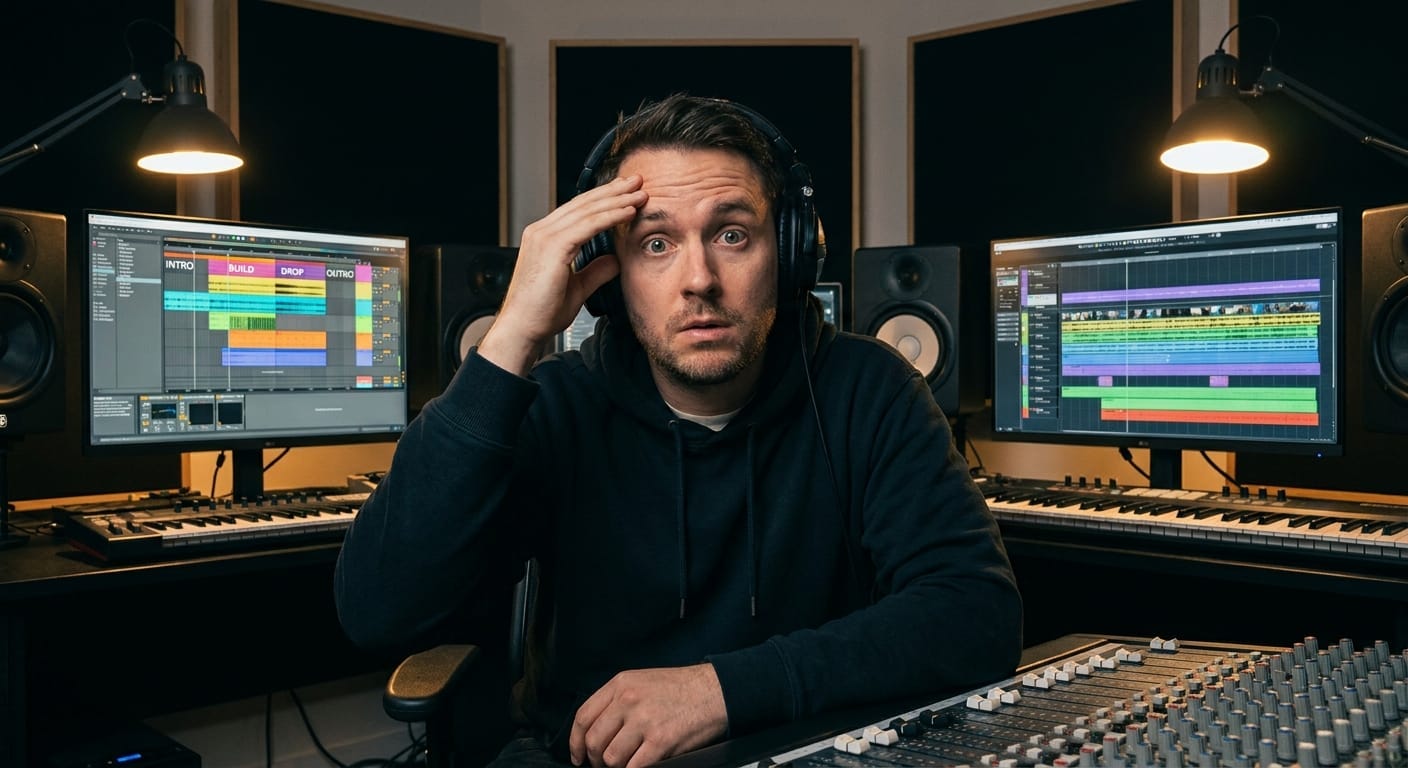
You finish a production. It sounds full. The drop lands hard. The arrangement breathes. You email it to a DJ friend. Six weeks later, you hear it back. It’s playing at minute 47 of a four-hour set. You don’t recognize it. Not because the DJ mixed it badly. But because you built it for the wrong context entirely.
The problem isn’t your production. The problem is that you produced a song. And a song doesn’t belong in a set the way you built it.
What You Produce for Matters
When you sit down to produce a track, you usually make an assumption: this is a standalone piece. It will be listened to alone. It will have a beginning, middle, and end. The listener is fresh. They’re paying attention. They expect an arc.
This works great if your track lives on Spotify. It fails completely if it lives inside a four-hour DJ set.
A set isn’t a song stretched across time. It’s a completely different compositional form. And it has completely different rules for what makes production choices work.
A song is a closed system. It opens. It builds. It peaks. It resolves. The listener expects that shape. They’re waiting for the payoff.
A set is an open system. It has no predetermined climax. The listener isn’t waiting for the drop. They’re waiting for the next moment. What comes before your track has already shaped their attention. What comes after will determine whether your production choice was right.
When you produce a track that will live inside a set, you’re not producing a song. You’re producing a movable element in a larger story. That distinction changes almost everything about the decisions you make.
Why Your Standalone Sounds Wrong at Minute 47
Let’s say you produced a four-on-the-floor techno track. Clean. Tight. Introduction lasts 32 bars. Build lasts 64 bars. Drop at bar 96. Sustain for 128 bars. Outro for 16 bars.
This is a perfect song structure. It makes sense alone. The listener gets oriented in the intro. The build creates anticipation. The drop delivers. The sustain lets them live in the moment. The outro closes the door.
Now imagine that track at minute 47 of a DJ’s set. The listener doesn’t need a 32-bar introduction. They’re already in. They don’t need a 64-bar build. They’re not starting their attention from zero. They need to know what this moment is in the context of what came before.
Your 32-bar intro reads as bloat. Your 64-bar build reads as stalling. Your drop reads as something that should have happened earlier.
The DJ might shorten the intro with a cue point. They might skip the intro entirely. They might move the drop earlier. But now your production isn’t being heard as you built it. It’s being adapted. And that’s fine. But it means you didn’t produce for where it would actually live.
Different Context. Different Production.
Here’s what changes when you produce for a set instead of for standalone listening:
The intro doesn’t establish mood anymore. In a set, the DJ already established mood in the last three tracks. Your intro should signal what this moment does differently. Sometimes that’s 4 bars. Sometimes it’s 16. But 32 bars of groove-building? That’s for albums, not sets.
The build doesn’t create anticipation from zero. The listener is already anticipating. They’ve been in rhythm-entrainment for 40 minutes. Their anticipation muscle is tired. Your build needs to redefine what they’re anticipating toward. Not build it from nothing.
The drop is no longer the point. In a set, the drop is a waypoint. What matters is whether the track shifts the narrative. Sometimes a drop does that. Sometimes a breakdown does. Sometimes a texture change does. The drop isn’t automatically the peak. It’s just a tool.
The sustain is where production lives. After the drop hits, you have maybe 30 seconds before the listener adapts to the new texture. Then what? A great set track has something to say in the sustain. A rhythm pattern that evolves. A harmonic movement. A texture shift. Something that keeps the listener’s attention moving.
This all sounds subtle. But it changes how you balance frequencies. How you arrange layers. When you introduce elements. How you let them disappear.
The Experiment: Produce the Same Idea Two Ways
Take a concept. Any concept. Let’s say: “Heavy kick with an ethereal pad underneath.”
Produce it as a standalone song. You’d introduce the concept cleanly. Maybe 8 bars of just the pad. Then the kick enters at bar 9. You’d let this combination breathe for 16 bars so the listener grasps it. Then you’d build: maybe add a vocal, a counter-melody, a rhythm element. By bar 32, the listener understands the song. By bar 64, they’re deep in it. By bar 96, you deliver the moment the song was building toward all along.
Now produce the exact same concept as an element for minute 90 of a four-hour set.
No intro. The kick and pad enter together at bar 1. By bar 4, you’ve made your statement. By bar 8, the listener knows what this track does. Bar 16, you’re already evolving it. Bar 32, you’re introducing the next thing. Bar 48, you’re closing the idea or transforming into something new.
The second version isn’t better or worse. It’s different. It assumes the listener is already paying attention. It respects their time. It serves the larger narrative instead of closing off into its own arc.
Production is Not Decoration
This matters because production isn’t decoration on top of a beat. Production is the architecture that decides how a track behaves in context.
Your EQ choices determine whether the track sits or stands out in a mix. Your reverb choices determine whether it feels intimate or expansive next to whatever played before it. Your rhythm choices determine whether the listener needs to adjust their body’s rhythm expectation or can flow straight through.
When you produce without thinking about where the track will live, you make production decisions that work for isolation but fail in context. You add reverb that sounds beautiful on your studio monitors but creates mud on a club system. You balance your low-end assuming the listener is fresh but it gets buried because the DJ already played three bassy tracks.
The DJ can’t fix architecture. They can shape it. But if the foundation is built for the wrong context, no mixing saves it.
Why This Matters Right Now
If you’re producing for sets (for DJ use, for streaming playlists that blend tracks, for any context where your production lives alongside other people’s production), your job changes. You stop thinking like a song-maker. You start thinking like an architect deciding how a room will function.
A room is evaluated based on how it works when you’re inside it, not whether it looks good in isolation. A track is evaluated based on how it functions inside a set, not whether it stands alone.
This doesn’t mean your production should be less ambitious. It means your ambition should be contextual. Instead of asking “is this drop big enough?” ask “is this drop right for minute 47?” Instead of asking “does the intro establish the mood?” ask “does the intro signal what’s different about this moment?”
The best set tracks aren’t the most complicated ones. They’re the ones that know exactly where they belong and are shaped for that space.
The Decision
Stop producing every track as if it’s a standalone song. Produce for the context where it will actually live.
If the track is for a set, shape it for the listener’s 47th minute, not their first. If it’s for streaming, shape it for the 30-second skip-past moment, not the full arc. If it’s for an album, shape it for its position in that story, not as a universal statement.
Context changes everything.
What’s the last production you finished? Where does it actually live? And does the way you built it match where it will be heard?