


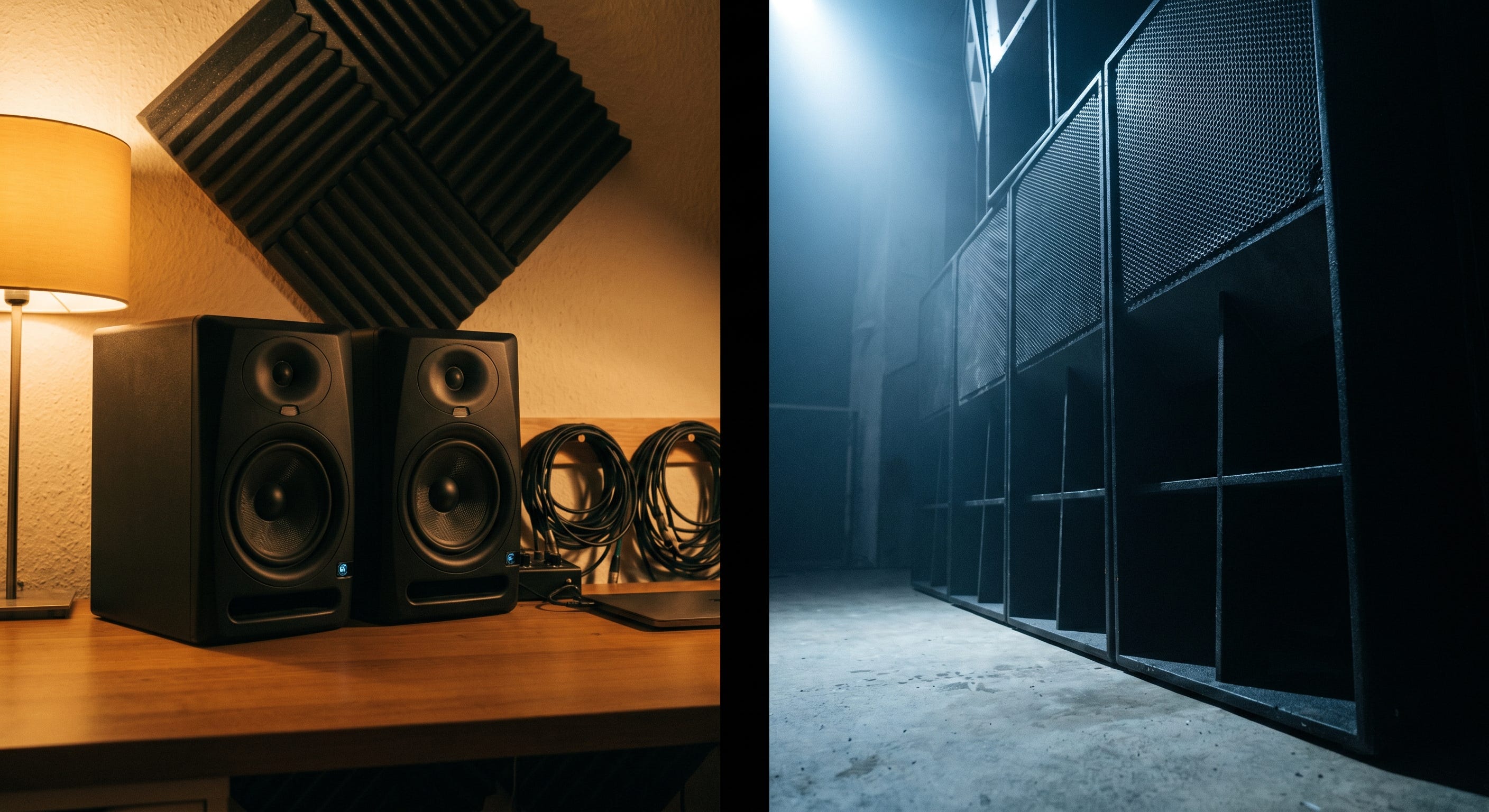
The kick sits perfectly in the bedroom. Sub full without being muddy. Transients with the kind of snap that makes you lean into the monitors a little. You’ve A/B’d it against reference tracks and every check tells you it’s right.
Then a DJ plays it in a club.
The kick is gone. Not quiet. Gone. The sub is an indistinct wall of pressure. Something in the 2-4 kHz range, where you carefully carved space, is cutting at a volume that makes people near the speakers take a half-step back.
Same production. Same mix. Different room.
The Neutral Room Myth
The assumption most producers carry: the room is passive. You finish the mix; the room just plays it. Translation rituals, mono checks, car tests: those exist to verify the mix is portable. If it survives a phone speaker, it’s fine.
It isn’t.
Your production doesn’t just play in a room. The room processes it. Every listening environment has its own resonant frequencies and reflection patterns. The room reinforces some frequencies and kills others. How reflective the surfaces are determines whether decays stretch out or stop short.
A club doesn’t play your mix. It rewrites it in real time, differently from your bedroom, the car, the DJ’s monitoring rig, and every other venue the track will travel to.
What the Room Is Doing
Your kick sounds punchy at home, in part, because your room is quietly reinforcing the frequency range it sits in. Standing waves build at specific frequencies based on room dimensions. Your bedroom has its own set. A club has a completely different one. The low-end boost your room was providing (the thing making your kick feel full and present) doesn’t come with the track. It stays in your room.
The midrange is less predictable. Hard parallel walls create comb filtering: peaks and notches across 1-4 kHz where reflections arrive at the listening position slightly out of phase. A vocal that sounds intimate and forward in headphones can turn harsh and fatiguing in a mid-size club. Not because the vocal changed. Because the room’s reflection pattern is smearing the frequencies that made it feel close.
Highs are the most room-dependent of all. A venue lined with acoustic panels swallows the top end that makes a pad shimmer. A concrete room scatters it into a bright, fatiguing smear. The shimmer that made your pad feel open in headphones can turn into a 10 kHz edge that makes people wince by the second chorus.
None of these are mix errors. They’re room errors, and the distinction matters because the fix happens at different stages. A mix error gets corrected at the fader. A room error gets anticipated at the production stage, before anyone plays the track anywhere.
Mixing for Rooms You’ve Never Heard
Previously we wrote about what your breakdown does to the floor. This is about what the floor does to your production.
When you mix a track for DJ use, you’re not mixing for one room. You’re mixing for every room the DJ takes it to. Five rooms, fifty rooms. None of them yours.
That’s a fundamentally different target than a great bedroom mix.
The kick transient that survives room diffusion isn’t centered in the sub. It’s the attack click in the 3-5 kHz range: the snap that cuts through even when the bass frequencies are doing something unpredictable in the room’s mode structure. Protect that range. Don’t EQ it back in pursuit of a cleaner top end (it took me a long time to stop doing this). It’s doing structural work that your bedroom never makes visible.
Comb filtering is what kills vocal presence in rooms with hard parallel walls. A slight boost around 2-3 kHz gives a vocal enough cut to hold through that smearing. Too much and it becomes harsh. Too little and the vocal disappears the moment the room takes over. The difference is roughly 1-2 dB, and you can only hear it on systems that expose what your bedroom has been hiding.
The Three-System Test
Take a production you’re working on. Play it on three systems with nothing changed between them.
Phone speakers first. No sub, no bass reinforcement: just midrange and treble. If your kick vanishes here, it has no attack energy above 200 Hz. That’s the same kick that disappears in a venue where the room’s mode structure doesn’t support your sub frequency.
Car speakers next. Moderate bass, compressed midrange, a high-mid peak around 2-4 kHz from the enclosure. Notice what competes. A vocal fighting the lead synth in the car will fight it in rooms where that frequency range is already being made unpredictable by reflections.
Something with real sub last: a subwoofer, a club system, whatever you have access to. The low end reveals itself here. Frequencies that sounded distinct at home blur together at volume with real sub extension in a room that reinforces them.
One note per system. If it’s the same note three times, the mix is done. Different notes means room-dependent weaknesses the track is carrying into every venue.
Remix until the notes converge. That’s producing for the room, not your room.
Produce for the venue, not your bedroom. The DJ will play it where you’ve never mixed.
Have you ever heard your own production in a club and not recognized it? That’s a production problem, not a DJ problem.