

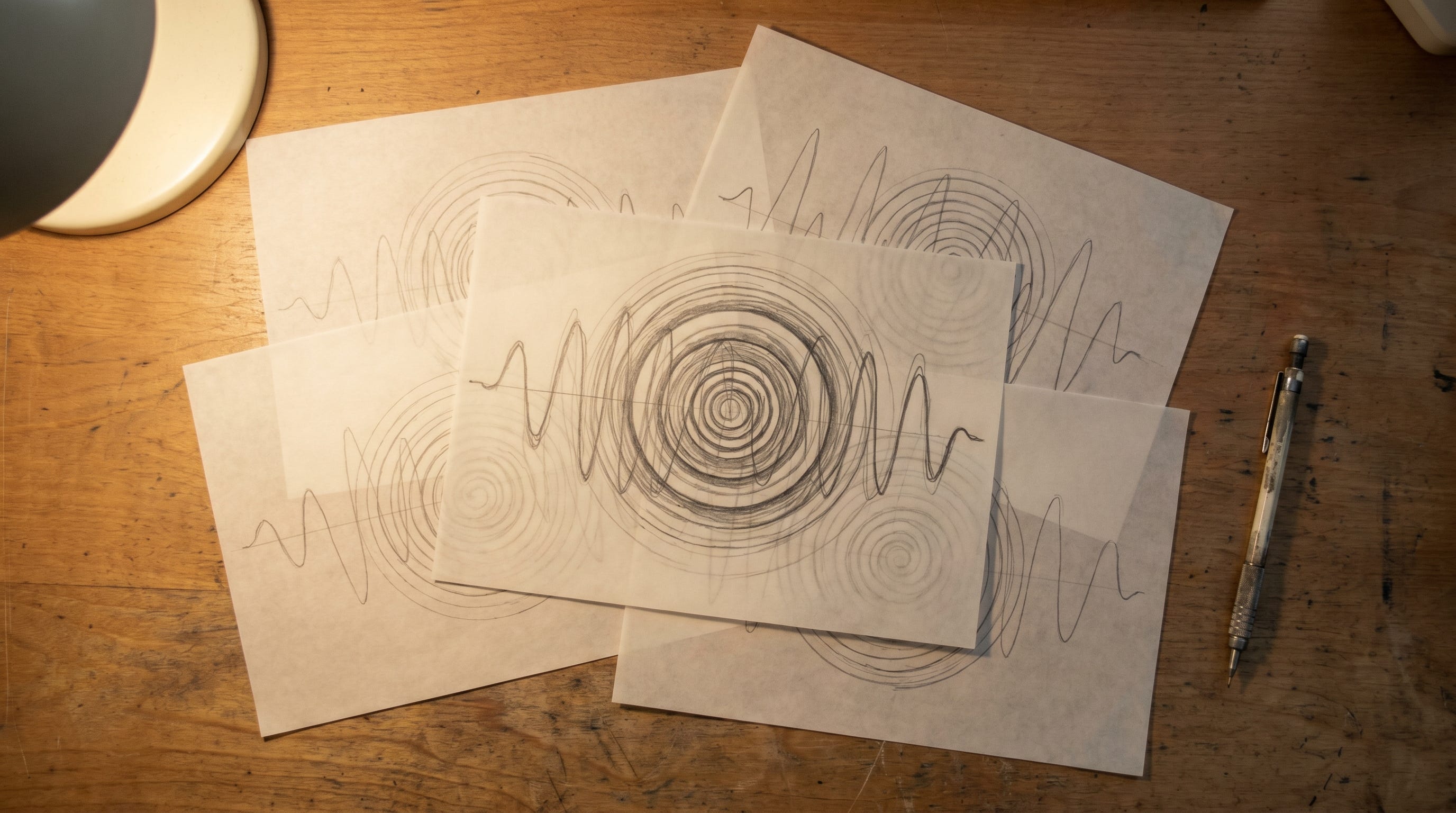
Pull any three of your sessions from the last year. Open the effects chains. Look at the reverb on the pads, the saturation on the synths, the space around the main melodic element.
Do that for three tracks. Then five. Then ten.
At some point you’ll see it: the same choices appearing across different productions. Not exactly, but close enough to be undeniable. The same reverb tail character. The same saturation texture on the mid-range. The same way you tend to treat the high-frequency content of your leads. Perhaps you didn’t plan that. But there it is.
That’s your fingerprint. And you’ve been building it for years without knowing.
What Most Producers Believe About Signature
Most producers think a signature sound is something you design.
You research the artists you admire. You figure out which processing chain creates that specific texture. You work backward from the sound you love to the method behind it. You experiment deliberately until you find something that feels distinctly yours. Then you build on it.
That framing is backward.
The producers I know who have the most immediately recognizable sounds didn’t get there through deliberate construction. They got there by making the same choices repeatedly: the same harmonic preferences, the same spatial decisions, the same tolerances for density and space, until those choices accumulated into something coherent.
Your signature wasn’t designed. It was deposited. Session by session, choice by choice, the same way a path gets worn into a field: not because anyone planned the route, but because everyone kept walking the same way.
What’s Actually Happening
Here’s the reframe: your sonic fingerprint isn’t something you build toward. It’s something you’ve already built without noticing.
Every session contains an archive of decisions. The reverb you reached for when the track needed air. The saturation you applied when something felt too thin. The way you tend to handle the sub range when the kick and bass are competing for the same space. These decisions happen fast, often intuitively, and you make the same ones repeatedly because they express something real about how you hear sound.
Over 20 or 30 or 50 sessions, those decisions accumulate. The pattern emerges before you recognize it.
This matters because most producers spend time trying to invent something that’s already there. They chase trends to sound more current, imitate influences to sound more polished, and in the process sand down the very thing that makes them distinct. Your fingerprint is in the choices you make when you’re not thinking about what you should sound like.
Why Recognition Changes Everything
There’s a practical difference between making unconscious choices and making the same choices consciously.
When you don’t know what your fingerprint is, you can’t strengthen it. You can’t ask “is this decision consistent with what I actually do?” You can’t know when you’re drifting toward someone else’s sound versus deepening your own.
Once you see it, you can make it deliberate. The reverb that kept appearing in your sessions: choose it with intention. Not because it’s familiar, but because it’s yours. The harmonic texture you kept gravitating toward: now it’s a tool, not an accident.
This is the difference between a producer who sounds like themselves on good days and one who sounds like themselves consistently. The second one knows what they keep returning to and returns to it on purpose.
The Overlap Test
Block out 30 minutes. Do this in order.
Pull your last 10 tracks. Finished or not, it doesn’t matter.
For each one, open the effects chain on three elements: a pad or texture sound, a melodic lead and the main rhythmic element. Don’t overthink which elements. Just the first three your eye lands on.
For each element, write down four things: the reverb type and approximate tail length (long and lush, short and tight, somewhere in between); the saturation character (harmonic, tape, clip; describe what it sounds like, not the plugin name); the high-frequency treatment (present, rolled off, bright but narrow); and the low-mid density (thick, hollow, tight, pushed).
Do that for all 10 tracks.
Then look at the columns. Not for exact matches. For tendencies. Where does the reverb tail land most of the time? How does the saturation character tend to sit? What do you do with low-mids when you’re not actively thinking about them?
The pattern in those tendencies is your signature. Not as a brand concept. As an actual sonic reality you can work with.
(I ran this exercise a few years ago and found I consistently over-treat the 2-4kHz range with a specific saturation character on almost every production. I’d thought it was a track-by-track decision. It wasn’t. It was the decision I always made. Once I saw it, I could choose when to apply it and when to leave it alone. The result was more controlled than anything I’d done before.)
What You Do With It
The point of finding your fingerprint isn’t to mechanically repeat it.
It’s to stop accidentally erasing it.
Most producers have a phase where they work hard to sound more like their influences. That’s useful early: you’re building vocabulary, understanding what’s possible, training your ear for what you want. But at some point the work shifts. You’re not learning language anymore. You’re finding what you have to say.
The overlap test won’t tell you what to do next. It’ll show you what you already do. What you do with that is where the interesting decisions start.
Your fingerprint got there because something in you kept making those choices. Not by accident. By instinct. The work now is understanding that instinct well enough to use it on purpose.
You didn’t invent your style. You discovered what you keep returning to.
What’s the one sound design element you’ve found appearing in almost everything you make, even though you never consciously planned it that way?
ASCENDANCE (Original Mix) is the most recent track where I made these choices deliberately: the saturation character, the reverb treatment, the way the mid-range breathes. If you want to hear what a discovered fingerprint sounds like when it’s been noticed and then used on purpose, start here.