

TL;DR
Suno says v6 can now change one section or one lyric while preserving the rest of a song. Studio 2.0 adds MIDI, effects, automation and a chat layer inside a browser-based DAW.
I don’t use Suno to make ZenOne music. My releases are human-made. I’m looking at this because targeted AI editing creates a useful producer test whether you use these tools or not.
That test is edit locality: change one thing, then listen closely to everything that was supposed to stay the same (regression).
In June, I wrote something that already needs a footnote: generation is addition by nature.
The point in The Sound You Can’t Remove was that a generator has no fear of filling an empty bar. A producer’s harder job is often subtraction: deciding what the track can lose without losing itself.
That distinction is getting less clean.
I don’t use Suno in my ZenOne production. My releases are human-made. I’m looking at Suno here because its new editing model raises a producer question I think matters even if you never put a generative tool in your workflow: when you change one thing, what else moves?
On September 9, Suno released v6. Its own release notes say the model can change one section of an existing song while preserving the rest. It can replace a single lyric without rebuilding the whole track, combine parts from multiple songs, isolate a sample and build around it. A month earlier, Suno Studio 2.0 added MIDI editing, effects, automation, a wavetable synth and a chat layer to its browser-based production environment.
I don’t think the interesting part is that AI can make another song faster. We already crossed that line.
The interesting part is that the generator is learning to take a note.
The first draft was never the hard part
A first pass can be impressive and still be useless to a producer.
You hear eight bars and like the atmosphere, but the kick is wrong. The vocal works until the last word. The breakdown is good, but the transition into it gives away the tension too early. In a normal DAW, those aren’t reasons to start over. They’re reasons to edit.
Production is full of narrow decisions. Move this note. Shorten that reverb tail. Pull one percussion hit forward. Keep the bass exactly where it is.
That last sentence matters.
The value of an edit isn’t only what changed. It’s what the edit managed not to disturb.
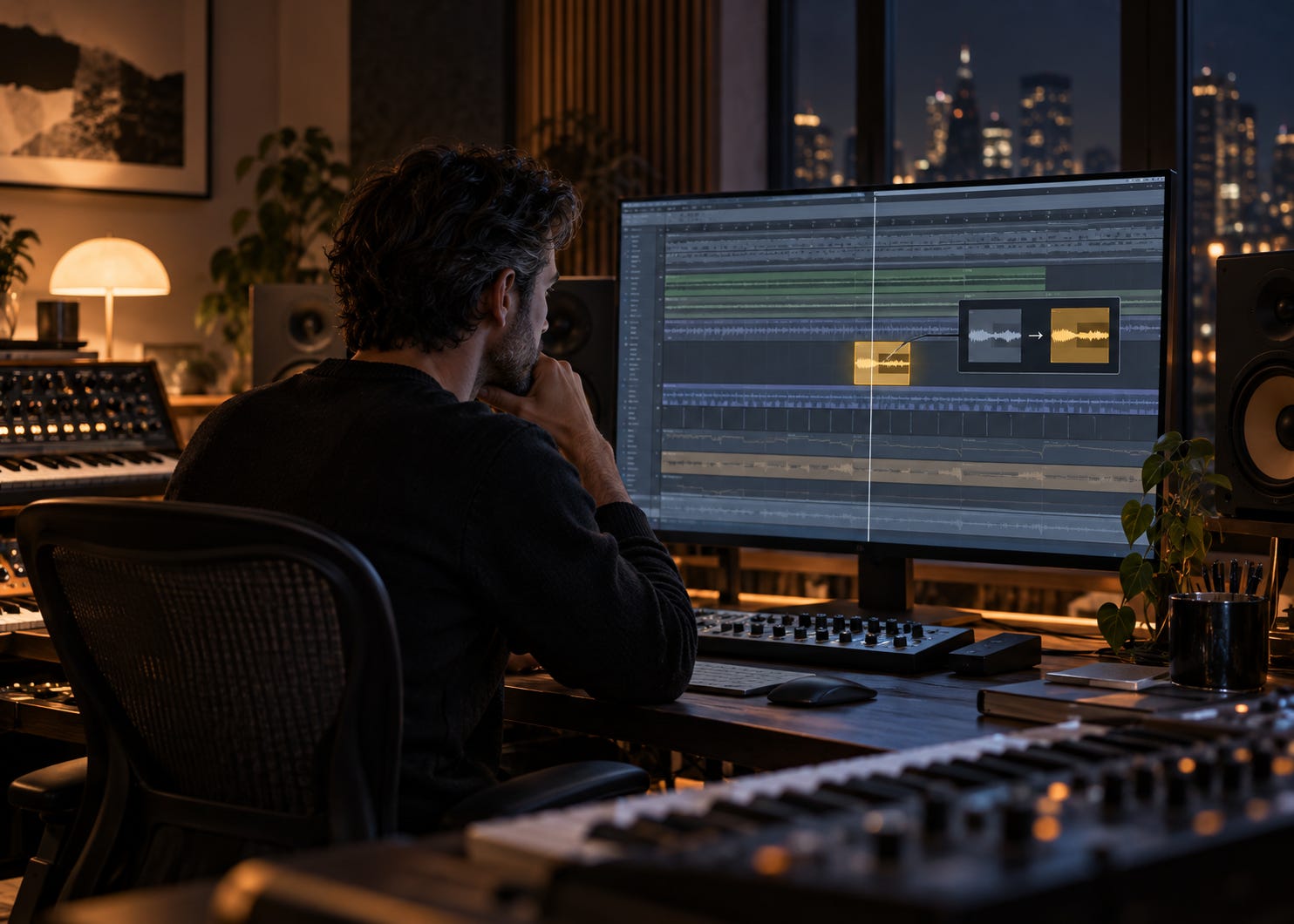
Suno’s v6 announcement is interesting because it makes preservation part of the product claim. The example isn’t simply “make a different chorus.” It’s change the chorus while keeping the rest of the song. Studio’s chat documentation pushes in the same direction: select part of a project, describe the change and let the system perform operations inside the multitrack session.
That’s much closer to production than one-shot generation is.
It also creates a much harder standard.
The new test is edit locality
I want a term for the thing producers should listen for here, so I’ll use edit locality.
Edit locality means the change stays where you asked for it.
If you ask for a different snare and the snare changes, that’s obvious. But did the groove around it move? Did the room sound change? Did the bass transient soften? Did the stereo image shift? Did a tiny vocal timing detail you liked get regenerated into something cleaner but less interesting?
Those changes might be subtle enough that the new version still sounds “good.” That’s not the same as being a precise edit.
A useful editor has to preserve context.
This is why the move toward generative DAWs matters more to me than another leap in first-pass fidelity. Studio 2.0 now has familiar production objects: MIDI clips, effects chains, automation lanes, synth parameters and a timeline. Suno says its chat layer can see what you have selected and make changes using operations available inside the project.
Those are all ways of narrowing the blast radius of a decision.
But the interface can look precise before the result actually is. A highlighted region on a timeline doesn’t prove everything outside that region remained musically identical. A text instruction that says “leave the bass alone” isn’t the same thing as a locked bass track.
The ears still have to verify the boundary.
Run the one-change test
If you use Suno or another generative music tool with targeted editing, don’t evaluate it by asking for the best song it can make. That tells you almost nothing about whether it can function as an editor.
Give it a smaller problem.
Start with a piece where you already know what you want to keep. It can be something generated inside the system or material you’re allowed to use there. Pick one exact revision. Not “make it better.” Something like:
Change the snare in bars 17 through 24.
Replace one lyric and keep the vocal phrasing around it.
Make the pad darker without changing the bass or drums.
Shorten one transition without changing what follows it.
Export the before and after versions. Match their playback level closely enough that louder doesn’t win by accident. Then ignore the part you asked to change for a moment.
Listen to everything else.
Did the kick keep the same weight? Does the bass enter on the same micro-timing? Did the vocal consonants around the edit move? Is the ambience the same? Did a cymbal tail disappear? Does the groove lean differently even though you never asked it to?
Then do the same edit again.
If the preserved material moves differently on every attempt, you’ve learned something important. The system may be a good generator with an editing interface around it. If the requested change stays local and the rest remains stable, that’s a different class of tool.
The score isn’t “version B sounds better.”
The score is how much of version A you were able to keep on purpose.
Control is what stays still
The shift is wider than Suno. Universal Music Group and ElevenLabs announced a licensed AI music platform on September 10 that’s intended to let fans make remixes, mashups and new interpretations from participating artists’ music. Suno’s v6 announcement talks about mashups, sampling and targeted revision. Studio is becoming more like a DAW.
Different products, different rights models, but the direction rhymes. AI music is moving from “give me a song” toward “work on this material.”
That changes the argument producers should be having.
The old debate was mostly about generation quality and authorship. Those questions aren’t going away. None of this changes my own workflow: I don’t use Suno to make ZenOne music. My releases are written, arranged, sound-designed, produced and mixed by me. They’re human-made, and if I ever use generative AI in the audio, composition, lyrics or vocals, I’ll say so explicitly.
But there’s another question now: what does control mean when the tool can revise instead of only generate?
I don’t think control means having more prompts. It means being able to make a narrow musical decision and trust the boundaries around it.
That’s familiar territory for anyone who works in a DAW. We freeze tracks because we don’t want them changing. We duplicate before destructive edits. We automate one parameter while leaving the others alone. We save versions because revision is partly the art of deciding what must remain true.
The generator becoming an editor doesn’t make that discipline less important.
It makes it measurable.
Ask the tool to change one thing. Then listen hardest to everything you told it not to touch.
Resources
Suno, “Introducing v6,” September 9, 2026: targeted section edits, single-lyric changes, mashups, sampling and multimodal creation.
Suno, “Studio 2.0 is here,” August 13, 2026: MIDI, audio effects, wavetable synth, musical typing, automation and chat inside Suno Studio.
Suno, “Updates to Suno Studio,” September 2, 2026: BPM-aware chat, undo for prompt edits, plugin workflow improvements and performance fixes.
Suno, “Introducing Studio 2.0,” August 13, 2026: additional detail on MIDI as a prompt source and the Studio chat workflow.
Universal Music Group, UMG and ElevenLabs strategic agreement, September 10, 2026: announced licensed platform for remixes, mashups and new interpretations using participating artists’ music.