

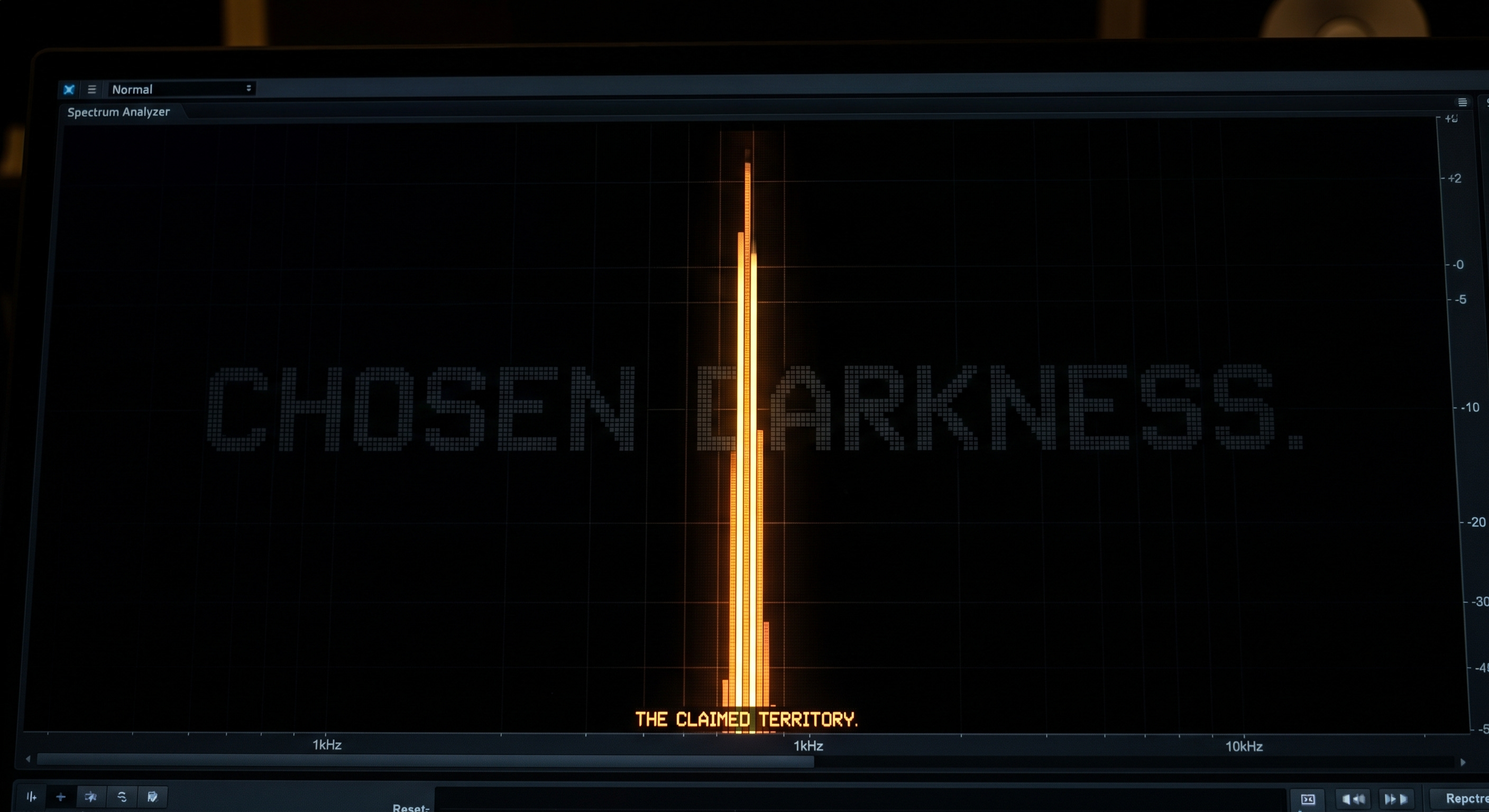
The plugin demo promised full spectrum response. Your mastering chain is catching everything that gets too loud. You’ve A/B’d your reference tracks and confirmed there’s energy across the whole frequency range.
You’ve filled the spectrum.
You’ve also made yourself interchangeable with everyone who did the same thing.
The producers with the most immediately recognizable sounds aren’t the ones who found the right plugin to cover every frequency band. They’re the ones who decided which frequencies are theirs and let everything else stay quiet or at least settle into the background. The absence isn’t a gap in the mix. It’s part of the strategy.
The Full-Spectrum Myth
Most mixing guides treat a balanced, full spectrum as the technical goal. It makes sense as a broadcast standard: you want energy where it should be and nothing extraneous. Gaps feel like problems. Thinness reads as incomplete.
That framing is correct for broadcast. It’s the wrong target for identity.
The producers who sound most like themselves aren’t the ones whose spectrum analyzer reads flat across the full 20Hz-20kHz range. They’re the ones whose mix has a specific spectral posture: deliberate presence in certain ranges, conspicuous absence in others. That posture is as identifying as a vocal fingerprint. When you hear the first two bars of a Jon Hopkins or Underworld production, you’re not hearing a full spectrum. You’re hearing a claimed territory.
You know whose it is before the drop.
The frequency bands they don’t occupy aren’t oversights. They’re what makes the occupied territory feel like it belongs to someone. A mix that’s trying to be everywhere is a mix that belongs to no one.
What the Empty Bands Are Doing
Empty frequency ranges aren’t neutral. They’re working.
Think about negative space in a photograph. A portrait against a clean background isn’t missing information: the empty space around the subject focuses attention, adds contrast, makes the face matter. Fill every corner of the frame and the subject competes with the background. The image loses its center.
Frequency space works the same way.
When a producer consistently leaves the upper 10kHz region sparse, that’s not a bandwidth limitation. The sparse high end is changing everything underneath it: the mids read warmer, the low end feels more dominant, the overall texture sits in a room differently than a mix that’s bright all the way up. That spectral posture communicates something. Listeners can’t describe it. They recognize it.
What fills the spectrum is what you’re showing. What stays empty is what you’re refusing to compete for. Both decisions define the territory.
(I spent two years trying to make my high end brighter because reference tracks in my genre were brighter. I kept reaching for air shelf EQ, brighter cymbals, more presence in the 8-12kHz range. My mixes got cleaner. They stopped sounding like mine. Eventually I backed off, and within a few sessions the identity came back. The difference was in what I stopped adding, not what I found.)
The Notch Test
Load a spectrum analyzer. Pull up a track by a producer whose sound you find immediately identifiable: someone where you’d know it in the first 10 seconds even without seeing the name.
Let the track play and watch the areas that aren’t moving. Find the frequency bands where almost nothing lives. Not the transient peaks that come and go. The consistent quiet zones. The places they don’t go.
Those aren’t problems in the mix. That’s their spectral territory, defined in part by what they chose not to claim.
Now apply systematic notch filtering: pull down 5kHz of bandwidth at a time and listen. Don’t listen to the cut itself. Listen to what the cut reveals about what was there. When you pull a band the producer has actually claimed and something irreplaceable leaves (that warmth, that edge, that specific texture), you’ve found it.
Do this for three tracks by the same artist. The same bands will hold the character across different productions.
That overlap is their identity, written in frequency.
Now open one of your own productions and run the same test. Where do your mixes consistently live? Where do they consistently leave space? The pattern in that answer is the spectral version of the fingerprint from last week: already there, already accumulated, whether you named it or not.
Claiming Your Range
The goal isn’t to strip three frequency bands and call it a sound. It’s to understand what you actually occupy when you’re not overthinking it, then make that choice with intention.
Most producers have a spectral tendency they’ve been building for years without naming it. The 800Hz warmth that keeps appearing. The way their high mids sit at 3-4kHz, present but not sharp. The sub that occupies a specific part of the low end rather than fighting across the whole 20-80Hz range.
That tendency is information. Once you see it, the question changes: not “why does my mix sound like this?” but “which frequencies do I want to own so completely that pulling them would pull me out of the track?”
That’s a different way to make decisions in a session. Not balancing everything. Asking: what is mine, what am I keeping, and what belongs to silence?
The spectrum you don’t use is half of your identity. Start treating it like a choice.
Own your frequency range. Let silence own the rest.
Which frequency band in your mix is so consistently occupied that removing it would remove something that sounds like you?
If you want to hear this in practice, ASCENDANCE (Original Mix) is the clearest example from my recent work: the decisions about what occupies the 2-4kHz range and what I left alone in the upper frequencies were made with this exact frame in mind.
Spotify · SoundCloud · YouTube