

TL;DR
Hearing the Osborne Brothers’ “Rocky Top” with Wendy brought back the Country Bears at Disneyland. I immediately imagined a version with psytrance and trance elements.
I kept the recorded banjo and added my own synth arpeggios. Getting the rolling bass to fit took some work. Once it did, this became one of my favorite projects.
The arrangement gives those repeating parts different entrances, with room for the banjo to leave and return.
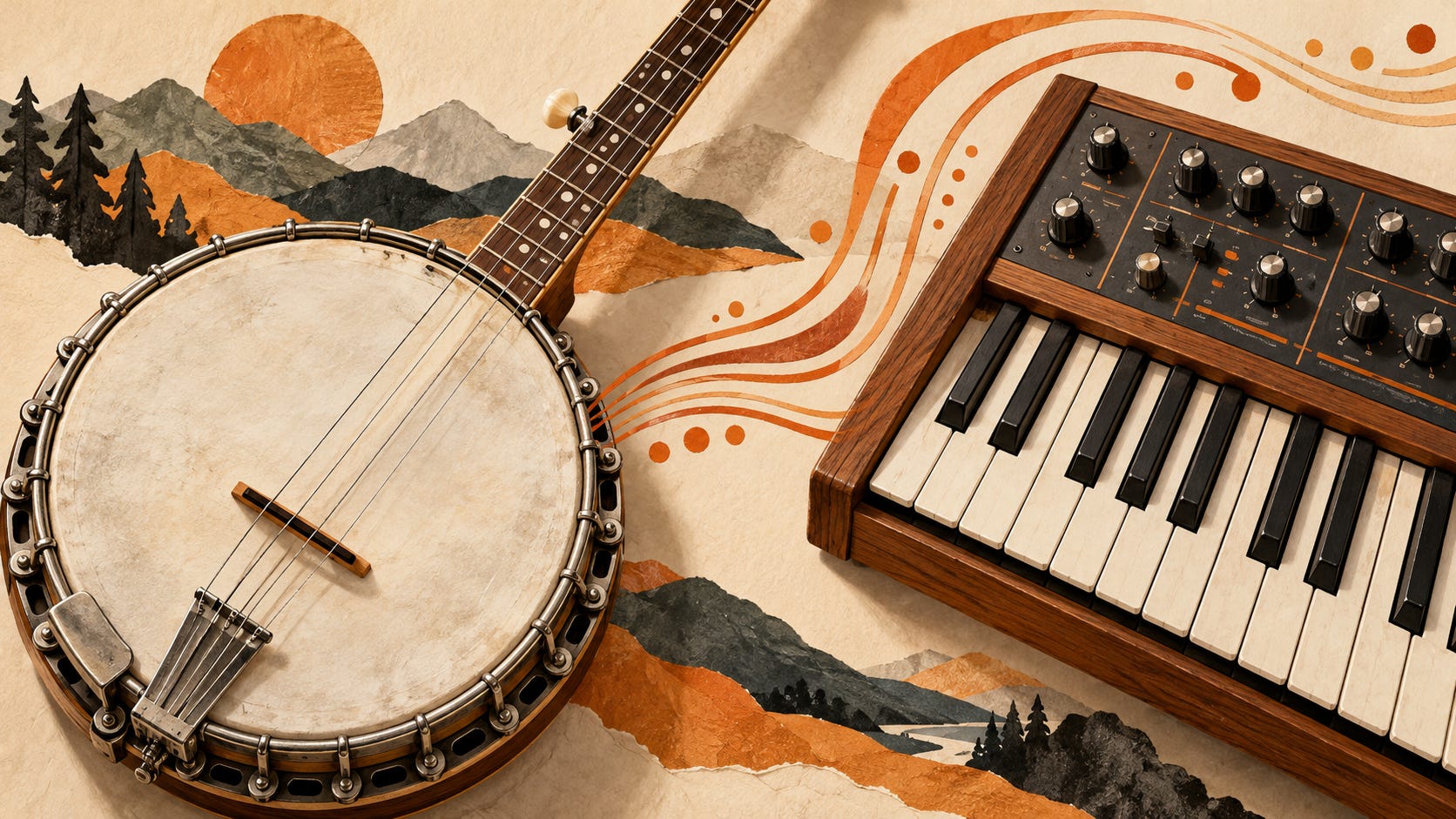
Wendy and I were going through some older songs a while back when the Osborne Brothers’ “Rocky Top” came on. I had total flashbacks to the Country Bear Jamboree at Disneyland. Then I started hearing what I wanted to do with it.
Psytrance. Trance. The connection was so damn obvious to me that I couldn’t not imagine it.
The banjo was a big part of that. Those quick, rolling notes already had the kind of movement I love in electronic music. I could hear them working with a rolling bassline and my own synth arpeggios, patterns that play notes one after another. I wanted to keep the Osborne Brothers’ singing and banjo and build around that.
I’d taken piano lessons when I was younger, then started taking banjo lessons. I loved the sound of the instrument and the patterns great players could pull out of it. Looking at how often I write arpeggios now, I can see myself reaching for some of that same movement.
My wife and I also recently made a major move from the West Coast to the Nashville area. That gave “Rocky Top” another connection for us. We both remembered it from Disneyland as kids. Now we were living in Tennessee, and I was making a 145 BPM psytrance remix of the Osborne Brothers recording in Ableton Live.
Listen: 37 seconds from my Rocky Top remix, with the Osborne Brothers’ banjo and vocals over a rolling psytrance bassline.
Before Tennessee, there were the Country Bears
The Country Bear Jamboree opened at Disneyland in 1972, the same year I was born. “Rocky Top” came later, as part of Country Bear Vacation Hoedown, which opened in February 1986.
Watch the Country Bears perform “Rocky Top” on YouTube.
Moving to Tennessee gives the song a different setting for us. I still hear the Country Bears in it, though.
The banjo connection goes further than remembering a particular song. In three-finger bluegrass playing, a roll is a repeating picking pattern. An arpeggio describes the notes of a chord played separately rather than together. They overlap: a roll can carry an arpeggio, along with melody notes and the repeated ringing note of an open string. Deering’s lesson on banjo rolls explains that relationship.
So “banjo rolls” is the a more accurate phrase for the playing that caught my ear. “Arpeggios” is still part of the connection. Hearing both now, I recognize something I keep returning to in my own music: a repeating line that carries the chords and keeps the music moving.
Once the bass fit
Getting the rolling bass to fit was the part I struggled with at first. By rolling bass, I mean a quick, repeating bass pattern under the kick drum. I wanted that constant movement to work with “Rocky Top.”
Once that came together, though, this song was a blast to work on. I didn’t feel like I had to fight it. I knew where I wanted to go, and I could enjoy building it out.
Keeping the banjo in the arrangement
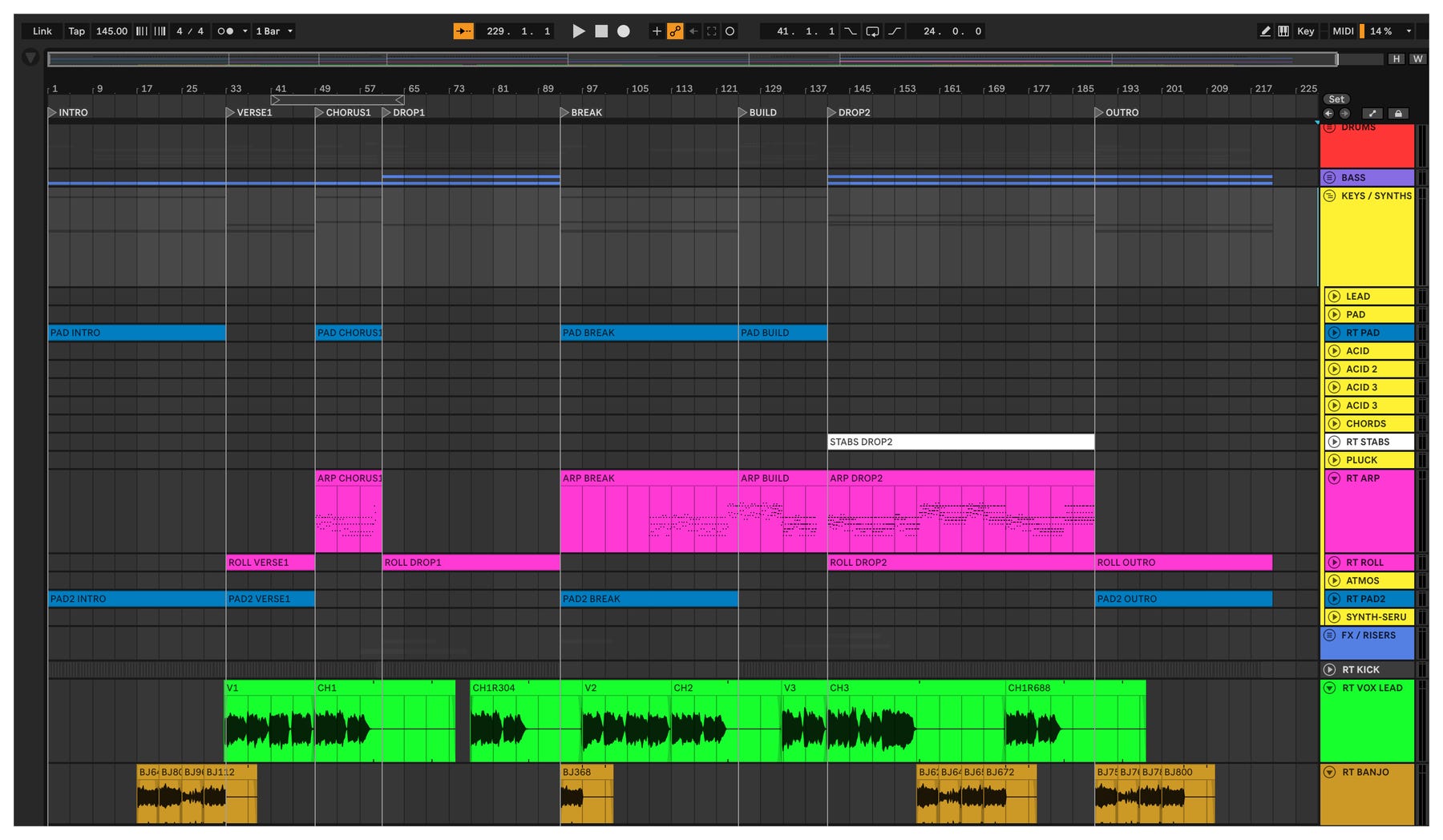
I wanted the banjo to remain a played part from the recording. I cut phrases from its instrumental break and placed them in the new arrangement, then gently adjusted the treble to keep the banjo from becoming too bright. I didn’t replace it with a banjo preset or turn every picked note into a new MIDI part.
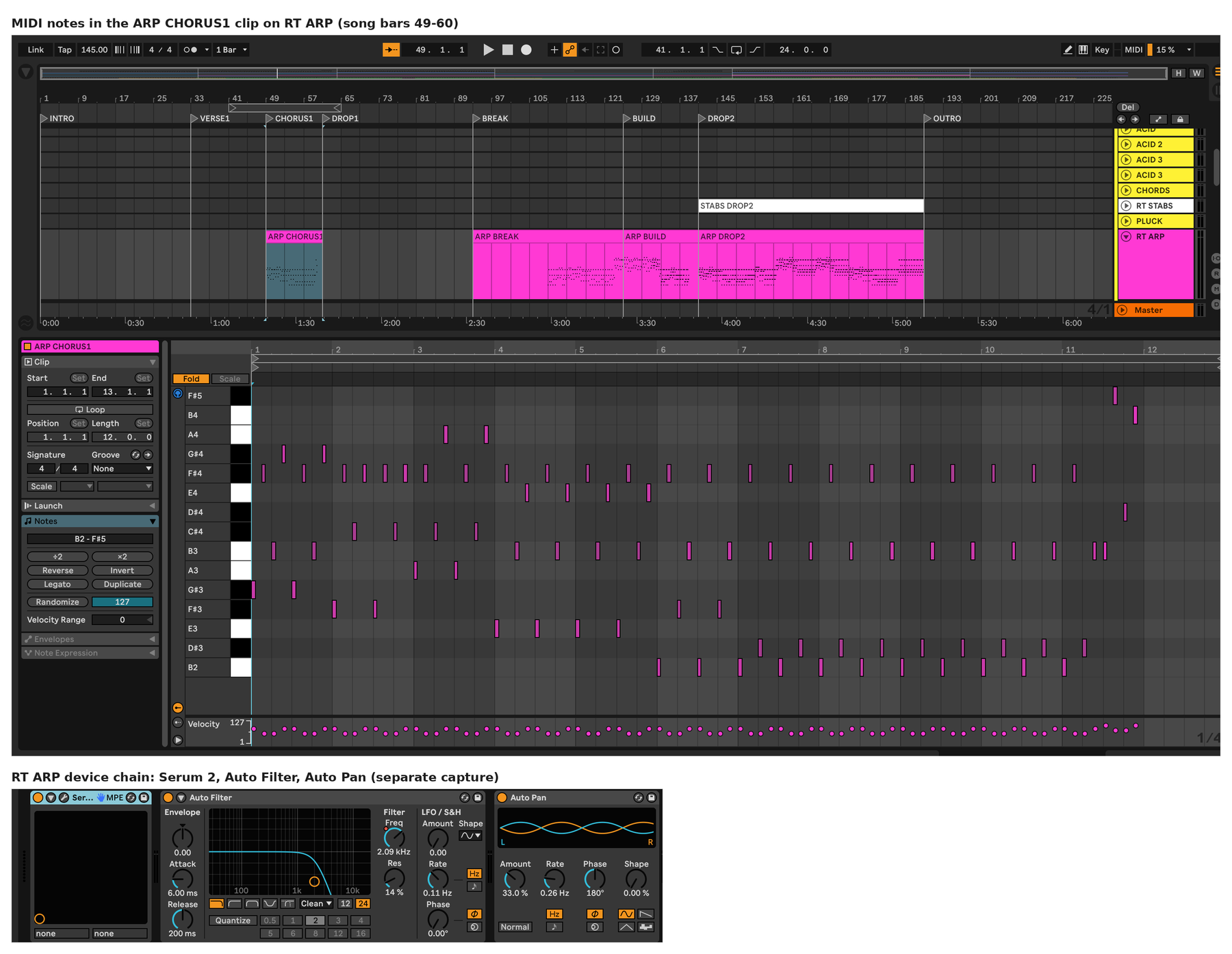
That leaves two different kinds of material in the session. RT BANJO contains the sampled performance. RT ARP contains a new synth part I wrote in MIDI, the notes that tell the instrument what to play. Keeping them separate makes it possible to decide where each belongs rather than treating them as one continuous layer.
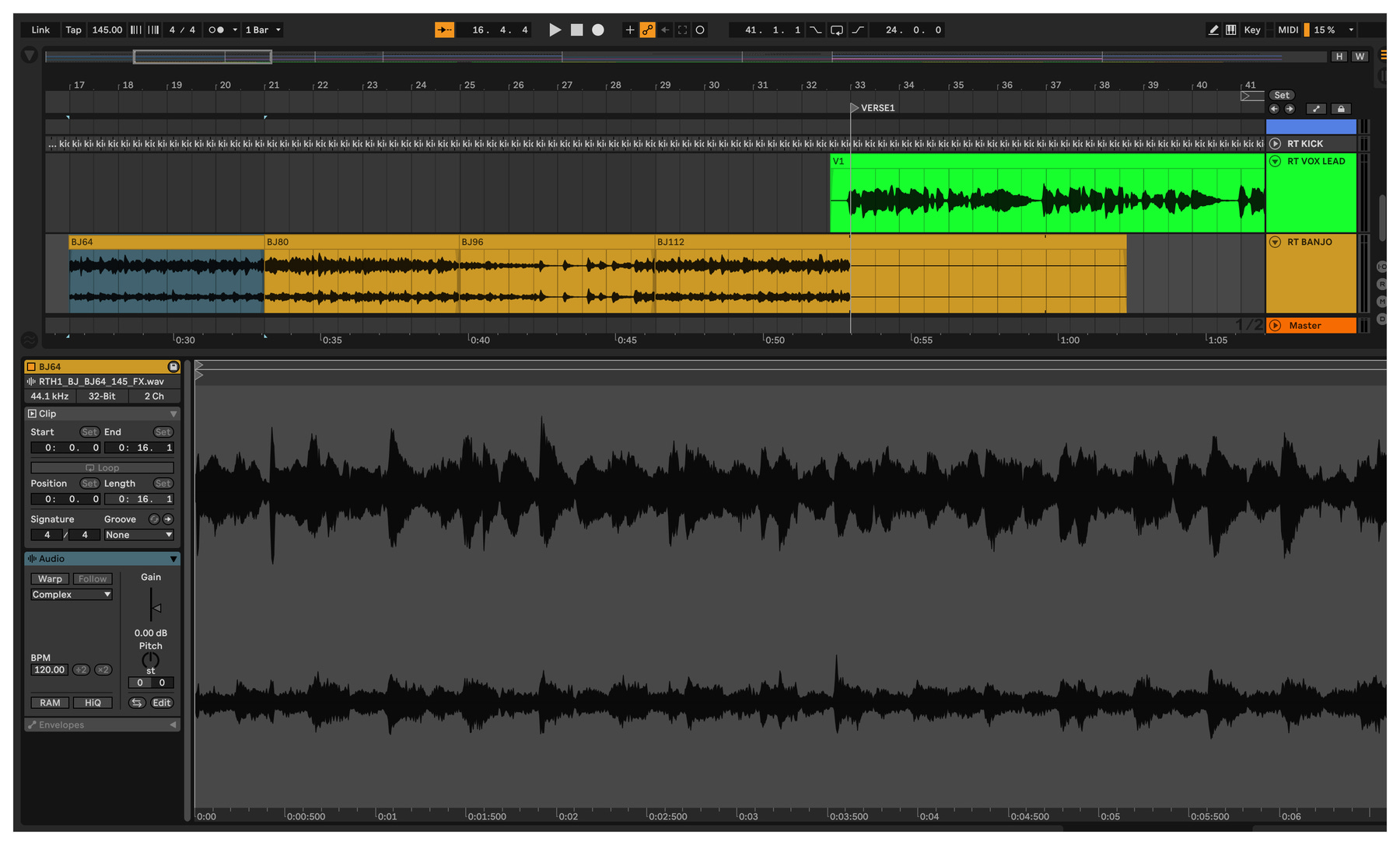
The synth arp enters in the first chorus. In the breakdown, the banjo comes first: the ARP BREAK clip starts at bar 93, but its notes don’t begin until bar 109. The arp continues through the build into the second drop. The banjo appears in the intro and breakdown, returns later in the second drop and comes back around the outro.
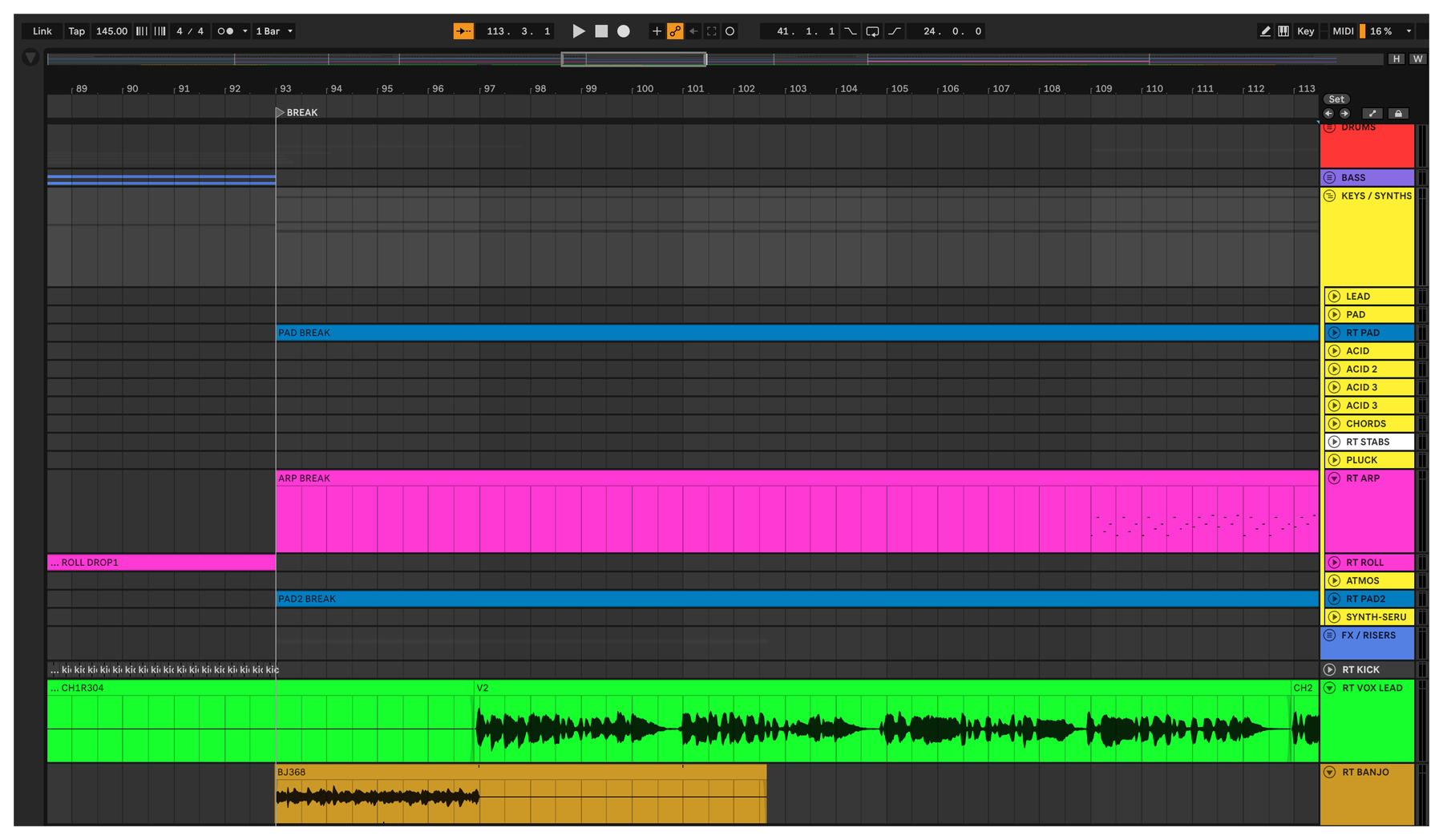
The second drop gives the clearest example. The synth arp starts at bar 141. The banjo returns around bar 157, sixteen bars later.
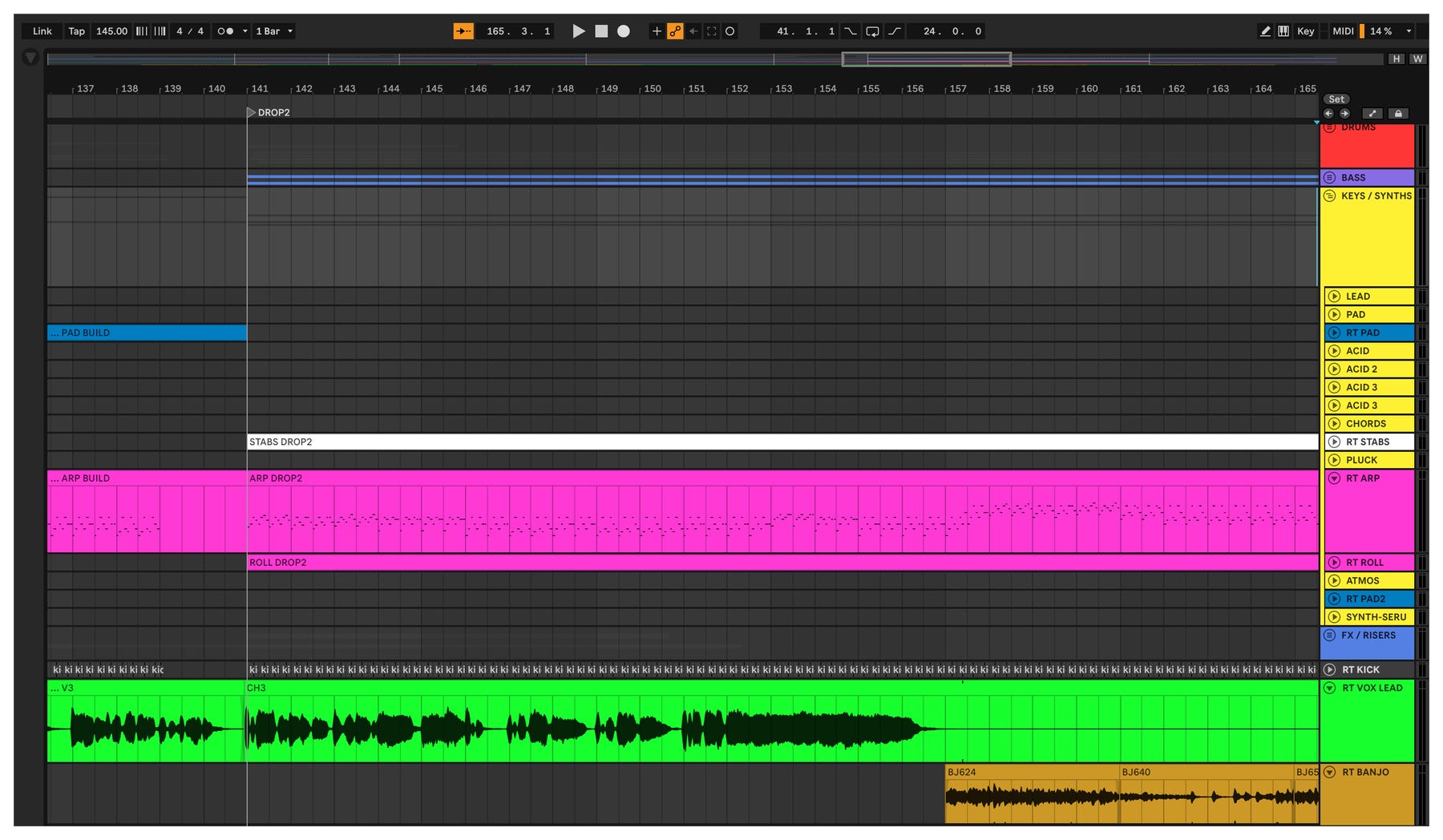
The synth keeps that repeating motion going for a while before the banjo returns. I wanted to keep the banjo in this version, but it didn’t have to play through every section.
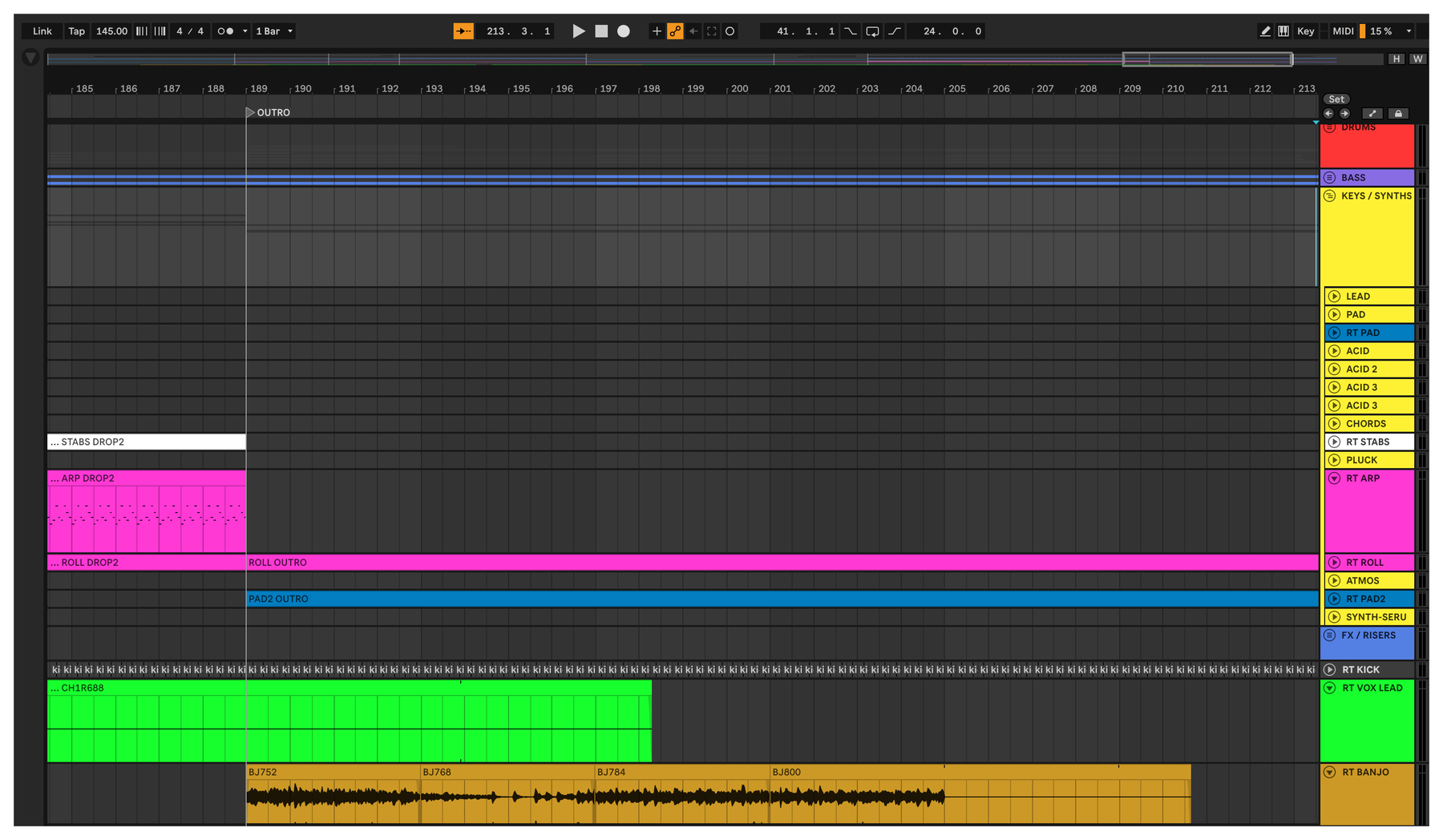
Keeping the parts separate gives me a more specific question than whether one is “too busy.” If the banjo is already supplying that rapid picking, what is the synth adding? The synth might move up and down differently, use higher or lower notes or put the accents somewhere else. If both parts repeat the same pattern at the same time, I want to hear whether that actually helps.
This is where the connection to my banjo lessons becomes useful in the studio. I don’t have to make a synth sound like a banjo to carry something I liked about the playing into a new part. I can work with the order of the notes and the way a pattern repeats, then choose a sound that fits the electronic arrangement.
Try the pattern with a different sound
There’s a small experiment you can do with a phrase you’ve played yourself or have permission to use.
Pick a short passage and listen to the movement between notes. Find the repeated notes, the changes in direction and the accents that make the phrase easy to follow. Write a short response on a plain synth. It doesn’t have to use the same melody.
Keep the sound simple at first. Change the note order, note lengths and accents until the response has the movement you want. A longer release, the setting that lets a synth ring after a note ends, can make the notes overlap. Shorter notes can leave more space between each sound. Either can work, but they’ll change how the pattern relates to the recorded instrument.
Then try different entrances. Bring the synth in with the sample. Bring it in after the sample stops. Let it establish a section before the recorded instrument returns. Listen across the transition, rather than judging the two parts only as an isolated loop.
In this remix, the parts have different entrances and places where they overlap. For your own track, the useful comparison is how those entrances change the section. A good loop doesn’t necessarily tell you when both parts should arrive.
For the MIDI approach, Ableton’s Live 11 reference explains how its Arpeggiator can turn held notes into a rhythmic pattern. You can also write the notes directly, as in this project’s RT ARP clips. You don’t need to add an Arpeggiator device just because you’re writing an arpeggio.
A quick song in a hotel room
“Rocky Top” was written by Felice and Boudleaux Bryant in Room 388 of the Gatlinburg Inn in August 1967. The inn’s history describes it as a break from the slower material they were writing for Archie Campbell. Felice wanted something more upbeat.
They were already experienced songwriters. The Country Music Hall of Fame and Museum documents their move to Nashville in 1950 and their work with the Everly Brothers, including “Bye, Bye Love” and “Wake Up, Little Susie.”
The inn says they wrote it in fifteen minutes. UT’s account says ten. I wouldn’t hang much on the difference, but I like that this song came out of a break from working on something else.
Bobby and Sonny Osborne were from Kentucky. By 1964 they’d moved to Nashville, joined the Grand Ole Opry and signed with Decca, according to the Bluegrass Music Hall of Fame and Museum. Bobby’s high lead voice and mandolin, with Sonny on banjo, were central to their sound.
Their “Rocky Top” came out in 1967 as the B-side of “My Favorite Memory.” A Tennessee legislative resolution marking the song’s fiftieth anniversary credits Nashville DJ Ralph Emery with helping it find an audience. The Osborne Brothers had a country chart hit with it before UT’s marching band adopted it.
I used an Osborne Brothers recording for this remix, including the vocals and banjo. I didn’t sample the Country Bears, a marching band or a Dolly performance.
The chorus belongs to the crowd, too
The Pride of the Southland Band first played “Rocky Top” at the Tennessee–Alabama football game on October 21, 1972. That’s the year I was born.
UT’s own history describes how strongly fans took to it. Band director W. J. Julian kept it in the program and later said leaving it out would provoke a mutiny. It became a fixture across Tennessee Athletics, even though the university’s official fight song is “Down the Field.”
Fans made “Rocky Top” theirs. The crowd sings it back, with the added “woo” that UT’s anniversary account notes became part of the tradition.
The late Dolly Parton had her own long connection to it. UT documents her singing it at the university’s 2009 commencement. In 2023, Tennessee Athletics announced a special Vols edition of Rockstar that included her live version. In that announcement, she talked about performing it at concerts over the years and knowing what it meant to Vols fans.
She also led it at Neyland Stadium during the Georgia game on November 18, 2023, with Peyton Manning accompanying her onto the field.
That’s a lot of history attached to this song. I like the idea of hearing my version in a game-day setting, but that’s still an idea. I’m not presenting it as a team’s version, and permission to make the full remix public is still pending.
A little more rock than I expected
The title also raises a question about the place we’re living now. Is the exposed rock around Middle Tennessee part of an old Appalachian landscape worn flat?
The geology connects the regions, but Middle Tennessee wasn’t simply the Smokies worn flat. Middle Tennessee State University’s Center for Cedar Glade Studies explains how ancient tropical seas deposited limestone, and later continental collisions helped raise the Nashville Dome. Erosion then exposed older layers and helped carve the Central Basin.
The Smokies tell a different part of that history. The US Geological Survey describes a mountain belt raised through continental collision and worn down over immense spans of time. The exposed limestone of the Nashville area isn’t simply the tips of those mountains poking through.
There’s a Rocky Top on Thunderhead Mountain in the Smokies. The Gatlinburg Inn mentions it as a possible inspiration for the name, but says the connection hasn’t been established.
For Wendy and me, this song still takes us back to Disneyland. Now there’s Tennessee, too, along with the version I couldn’t stop hearing when we played that old recording.
It’s definitely one of my favorites. There was work to do, especially with the rolling bass, but once that fit, I could let go a little and trust where the song was taking me. The muse did what the muse does.
The full remix remains private while I seek permission to share it. This is an unofficial production project, with no team affiliation or endorsement.
Resources
Gatlinburg Inn: A Brief History of Rocky Top. Origin account; the specific mountain inspiration remains uncertain.
Country Music Hall of Fame and Museum: Boudleaux and Felice Bryant.
Bluegrass Music Hall of Fame and Museum: Bobby Osborne and Sonny Osborne.
Tennessee Senate Joint Resolution 322. Song, recording and university history.
Tennessee Athletics: Traditions and UT: 50 Years of Rocky Top.
Tennessee Athletics: Dolly Parton and the Vols edition of Rockstar.
Disney Parks: Country Bears history and Yesterland: Vacation Hoedown.
MTSU: Glade History and USGS: Geology of Great Smoky Mountains National Park.
The screenshots show the H1d version of this project. The exercise above is something you can try in your own session, not a step-by-step account of how I made this remix.