

Placing Sound Is Choosing Perspective
When you open a new session, you are staring at a flat screen. Two dimensions. Tracks run from left to right; faders go up and down.
But if you mix based on what you see, your music will sound exactly like the screen: Flat.
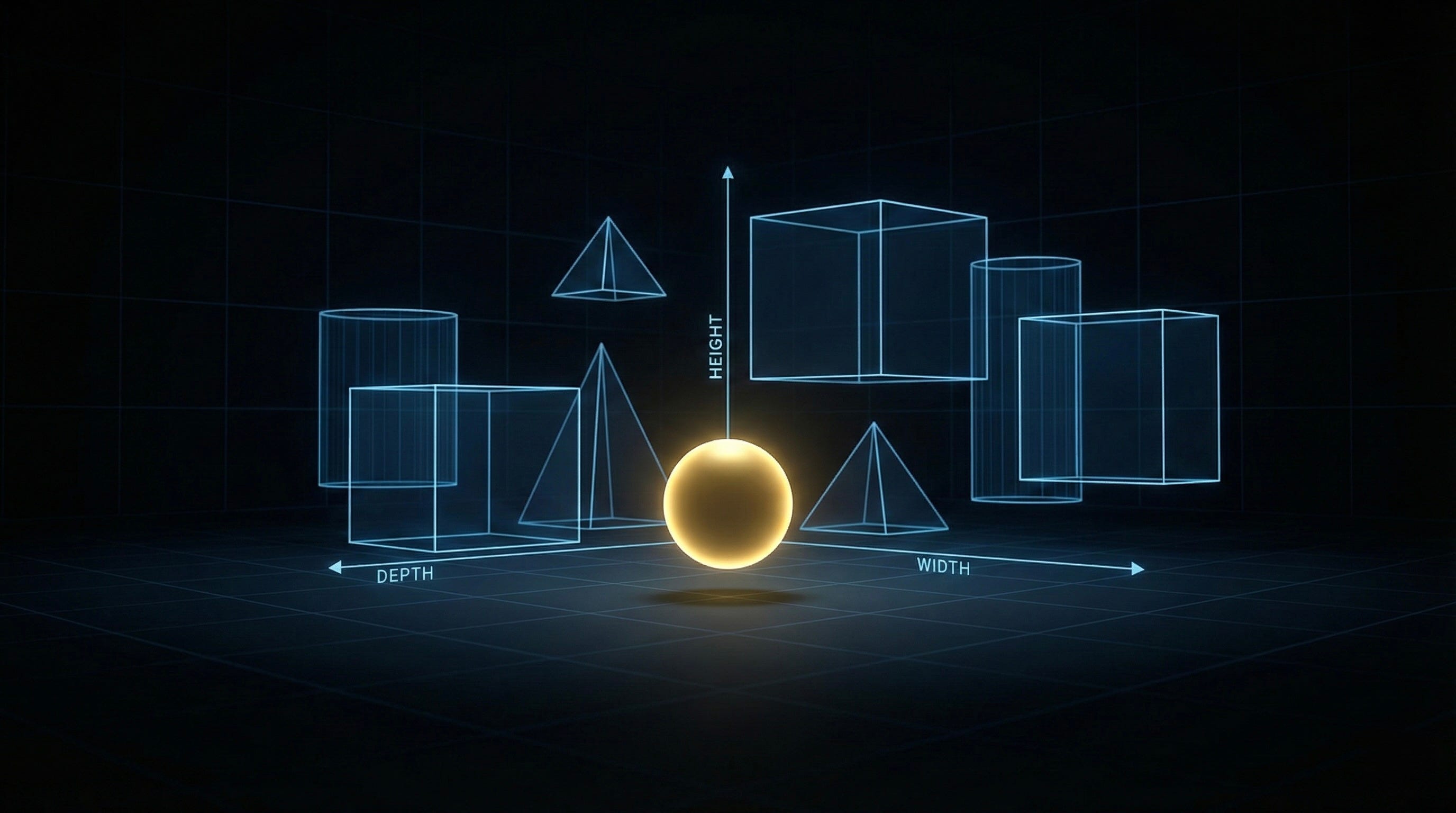
Mixing is not about balancing levels. Mixing is about constructing a three-dimensional world inside a pair of speakers. It is an act of architecture.
Every sound you place, specifically the vocal, must inhabit a specific coordinate in that world. If two sounds fight for the same coordinate, you get mud. If a sound floats without a coordinate, you get confusion.
To place the voice correctly, you have to stop thinking in terms of plugins and start thinking in terms of Perspective.
The 3D Coordinate System
Imagine your mix is a stage. You are the director, standing in the center of the audience. You have three tools to move your actors (the sounds) around this stage.
1. Level is Distance (The Z-Axis) This is the most critical and ignored dimension.
Loud = Close. The singer is whispering in your ear.
Quiet = Far. The singer is at the back of the stage.
The Mistake: We often try to make everything loud. When everything is loud, everything is in the front row, screaming at the listener. There is no depth. To make the vocal huge, you must push the other elements back.
2. EQ is Height (The Y-Axis) Psychoacoustically, human beings perceive high frequencies as “up” and low frequencies as “down.”
High Frequencies: The air, the cymbals, the breath of the vocal. These float near the ceiling.
Low Frequencies: The kick, the bass, the body of the vocal. These anchor the floor.
The Mistake: Trying to make the vocal dominate every frequency. A vocal cannot live on the floor with the kick drum. You must carve out its vertical slot so it can stand tall without tripping over the bassline.
3. Panning is Width (The X-Axis) This is the easiest dimension to understand but the easiest to abuse.
Center: The anchor. The Kick, Bass, and Lead Vocal usually live here because they drive the story.
Sides: The decoration. Pads, FX, and Background Vocals.
The Mistake: “Big” does not mean “Wide.” Big means Contrast. If you pan everything hard left and right, you lose the center. The vocal feels thin because it has no solid wall behind it. You need a narrow center to make the sides feel wide.
The Vocal as the Narrator
Once you visualize this 3D box, “placing the vocal” becomes a narrative decision, not a technical one.
Ask yourself: Who is this singer?
The Intimate Confessor: They are telling a secret.
Placement: Dead center. Very loud (Close). Darker EQ (Less height/air). Dry (No room to distance them).
The Ethereal Guide: They are a spirit in a dream.
Placement: Slightly lower level (Mid-distance). Brighter EQ (Floating up). Washed in Reverb (Pushed back in the room).
The Commander: They are leading an army (or a rave).
Placement: Center. Compressed heavily (Locked in place). Cutting mid-range (Eye-level).

Perspective requires Commitment
The reason many mixes fail is that the producer refuses to choose a perspective. They want the vocal to be intimate and distant. They want it to be wide and focused.
You cannot be in two places at once.
When you mix, be decisive. Pick a coordinate. Put the vocal there. Then, arrange the rest of the band around it.
If the vocal is in the front, the synths must step back (Reverb/Low Pass).
If the vocal is in the clouds (High/Wet), the bass must hold the ground (Low/Mono).
Close Your Eyes
The screen is a lie. The meters are just hints. The only truth is the image in your head.
Next time you struggle to place a vocal, close your eyes. Visualize the stage. Where is the singer standing? Point to them.
If you can’t point to them, they aren’t there yet. Move the fader (Distance), turn the knob (Width), or cut the lows (Height) until they snap into focus.
Build the world. Then let the listener live in it.