

I put out a track called Cascade (Original Mix). It was an experiment, and I said so. Then I sent it around to people who listen to new music for a living and got every opinion at once.
One added it and called it a standout. A few said it ran too long. Fair enough, but the long version was meant to unfold as a journey. It asks you to stop waiting for the next obvious cue, let the music fill the space, and follow the patterns as they develop. Some people seem to lock into that internal language immediately. Others don’t, which is part of making something that isn’t built around the shortest route to the payoff. A shorter cut was already finished for release the following week and would eventually sit alongside my other radio edits in The Algorithm’s Cut.
One curator called it an “overloaded cartoon soundtrack,” said it sounded like an unfinished draft, and told me to rebuild it around the instrumentation and arrangement of a reference track or it would “have no form.” Even the samples, loops, synth presets and BPM, apparently, had to stay inside the approved boundaries of a specific genre. There were no samples or loops. Every sound was synthesized and shaped to interact with the others, creating rhythms, tensions and textures that emerge between the layers rather than living inside any one of them. Then, after suggesting I find someone else to finish the mix and master, the same note offered those services for hire.
That stung for a bit. Then I separated the useful question from the genre policing and the sales pitch, and filed the rest where it belonged. Genre labels, arrangement conventions, sound selection and form are arguments about taste and intention. You can lose those arguments and keep walking. I make experimental music on purpose.
But two of them said the bass was weak, and that isn’t purely an aesthetic judgment. It either translates or it doesn’t. So I didn’t argue, and I didn’t trust my own ears either. I listened on multiple systems, then measured it. Before I looked, I decided what would count as losing: if the low end came apart when I summed it, they were right and I had a remix to do.
The part of the low end that isn’t an opinion
Everything in 2026 is pushing you wider. Immersive this, spatial that, a stereo imager on every bus. So when your bass feels small the move seems obvious: make it wider. Drop a widener on the low end and it blooms. Huge.
Up top that’s a gift. The air, the pads, the reverb tails all earn their width.
Down low, width is a trap. A specific, measurable one, which is the good news.
Why you can’t hear a wide sub, but a mono rig can
You can’t reliably place a low note in space, and the reason matters, because the folk version is wrong. Your ears use two cues: which ear hears it louder, and which hears it first. Down low the first one is gone. A bass wave is many times longer than your head, so it bends around it and both ears get the same level. What’s left is timing, and timing down there is fragile. In a real room the reflections and the modes smear it.
So this isn’t “bass is non-directional.” In a lab, on headphones, with a pure tone, people do better than the folklore claims. In a room, hunting for the sub, they don’t. It’s why one sub in the corner fills a club and nobody looks for it. Which means a stereo sub isn’t buying you width you can hear.
What it is buying you is a phase relationship between left and right. And nearly every system that matters folds the low end back together: club rigs run their subs in mono, phones and Bluetooth pucks are one speaker, vinyl has to be cut with mono bass or the needle jumps the groove. When left and right aren’t the same signal down there, summing them cancels, and your bass thins by a different amount depending on where you’re standing.
The ears lie, the room lies, and this is the third liar in the series: the one you introduce yourself, with a plugin, chasing size.
So you get width you can’t hear, paid for with low end that vanishes on the systems you want to land on. Bad trade. I call the line where it flips the mono floor. Above it, stereo is size. Below it, stereo is risk.
I wrote my own version of this in February, as a rule: keep everything under 150 Hz mono. I’d revise that now, and not because 150 is wrong. Because handing you one number was the mistake.
The floor isn’t a constant. It sits wherever your stereo content stops being audible as width and starts being a bet, and that moves with your bass sound, your arrangement, your genre. Ask a mastering engineer and you’ll hear 150, sometimes 200. February me said 150. Cascade measured nearer 120. We’re all right about our own material, which is the tell that what you want is a method, not a number.
Cutting engineers have folded bass to mono for decades, with a tool named the elliptical equalizer, because vinyl forced them to long before phones did.
Putting my own track on the bench
The weak-bass complaint. Instead of defending Cascade or believing it, I measured.
Below 120 Hz, the left and right channels came back at +0.993 correlation. Meaning they’re already one mono signal. Fold the whole track to mono and the low end moves 0.02 dB. In the drops, where the bass has to hit, it held at 0.999. There was nothing down there to cancel. Whatever “weak” meant, it wasn’t a phase problem. My sub was already mono. (Part of me wanted the bug. A bug you can fix in an afternoon.)
One stretch does wander. Around 3:45 the correlation falls to 0.39 and nearly a third of the low band swings to the sides. It’s a quiet passage for introspection, which is why it happens and why it barely matters: there’s almost no bass in there to lose. I’m flagging it because anyone who runs this will find it, and I’d rather say it first.
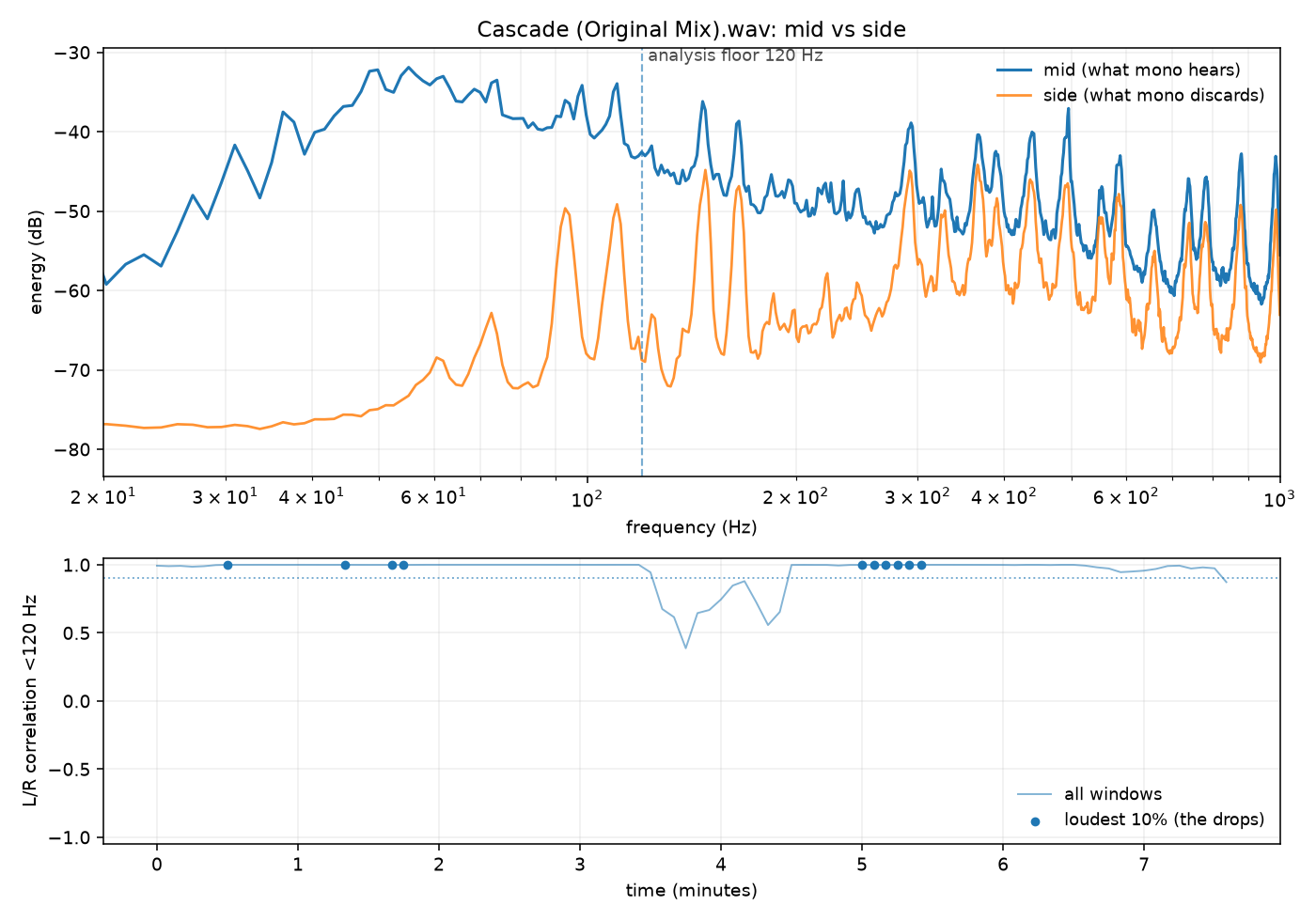
You don’t need my toolchain, just a correlation meter. Your DAW has one.
Put it on your master or bass bus and play the drop. Near +1 means the low end is mono and safe. Drifting toward zero, or below it, means stereo energy under the mono floor waiting to cancel on somebody’s system. The mono button still works, but it’s the blunt version. It tells you the bass thinned. The meter tells you where, and at which bar.
The fix is boring and it works. Mono everything below the floor, and find the floor rather than inheriting it: start at 120 Hz, walk it up toward 150 if the meter still wanders, down toward 100 if you’re losing something you can hear. One control in most DAWs. Keep the width up in the harmonics where the ear can use it. Then check the meter holds near +1 where the sub lives.
What the meter is for
An “expert’s” opinion and a correlation meter aren’t the same kind of thing. One is a taste you can take or leave. The other is the room and the club and somebody’s phone, testifying in advance.
Experiment with everything above the mono floor. That part is yours, and nobody gets a vote unless you let them. Below it, stop arguing and let the physics decide.
What’s the last track you widened to make it feel bigger, and would its low end survive a mono club rig tonight?
How I measured this
Python, reading the released 44.1 kHz stereo master with soundfile, filtering and spectra from SciPy. Nothing here needs a plugin you don’t have, and nothing was uploaded anywhere. I like to build and create things.
I split the file into mid and side, took Welch power spectra (32,768-sample windows, half overlap) and integrated the energy band by band. For the phase question I ran a fourth-order Butterworth low-pass at 120 Hz in both directions, forward then backward, so the filter contributes no phase shift of its own, then took the Pearson correlation of left against right. Across the whole 7:45 that came to +0.993, with 0.5 percent of the sub-120 energy sitting in the sides and a 0.02 dB change when summed to mono.
Then I did it again in five-second windows, because a whole-track average will happily hide a bad drop inside a quiet intro. Ranking the windows by loudness and looking only at the top ten percent, where the bass actually lands, the correlation was 0.999 at both the median and the minimum, with 0.03 percent of the low band in the sides. Loudness came from ffmpeg’s EBU R128 meter: -11.5 LUFS integrated, and a low-versus-high tilt of +10.2 dB, which is the muddy finding above.
What this does not prove: a correlation near +1 says the low end won’t cancel. It says nothing about whether the bass is any good. Those are separate questions and only the first one gets settled by a number. I measured the master rather than the stems, so it tells me the sum behaves, not which element earned it. And a DAW’s correlation meter uses shorter windows than I did, so it’ll twitch where mine reads calm.
Resources
Jens Blauert, Spatial Hearing: The Psychophysics of Human Sound Localization (MIT Press). The standard reference on how localization works, and why it degrades as frequency drops.
Attack Magazine, “Mono-Safe Stereo Width”. Why low-frequency stereo content collapses when summed, and how to keep the bottom mono.
sonible, “Avoiding the Collapse: From Stereo to Mono”. Mono compatibility and where phase cancellation comes from.
Previously in this series: Your Low End Is Lying to You and Who Gets the Downbeat?. The 150 Hz rule I’m revising here came from Width Requires a Strong Center.