

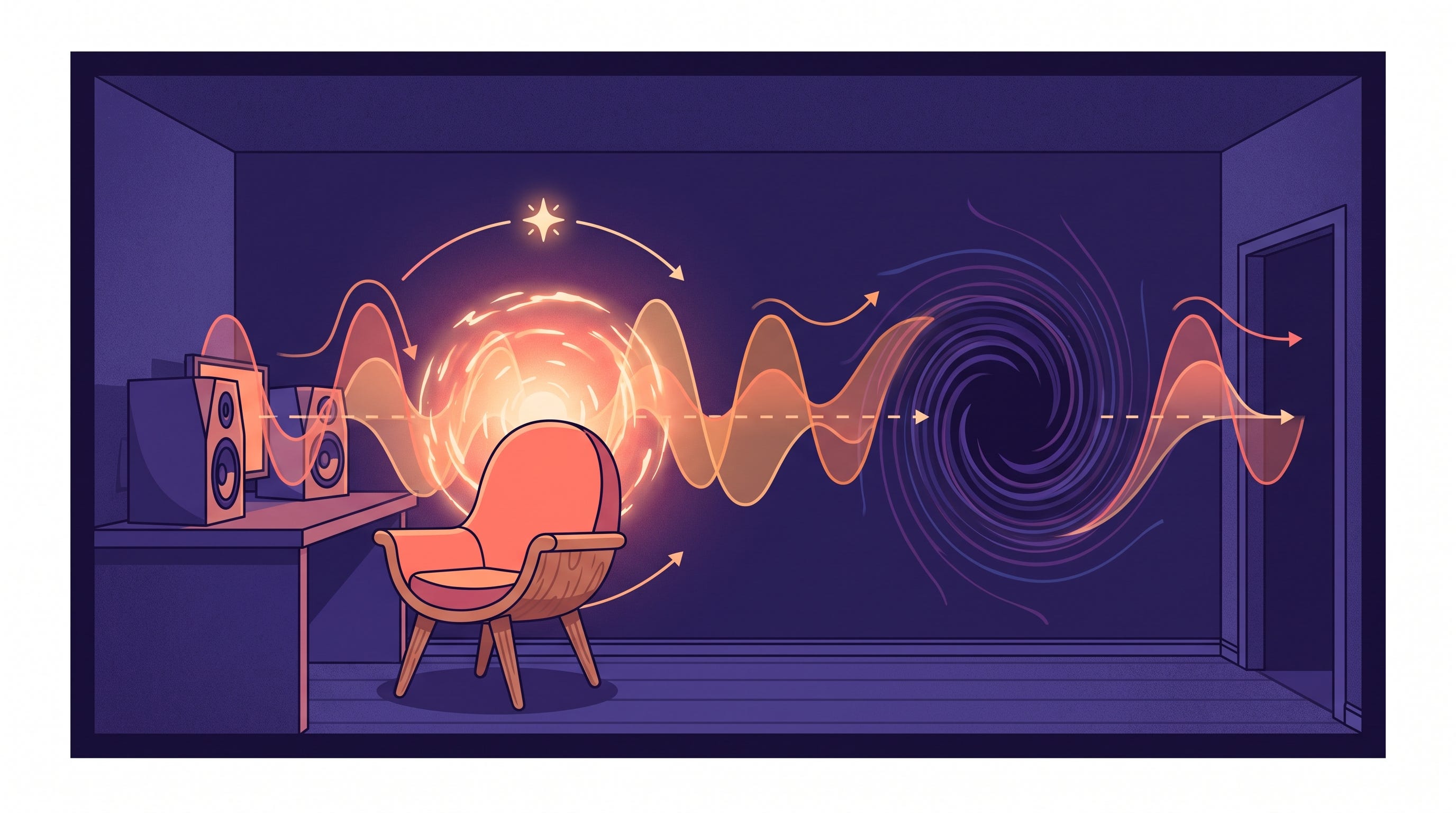
The bass on your track has two settings, and neither one is real. Turn your monitors down to almost nothing and listen to the bass. It nearly disappears. Turn them up loud and it comes back huge, maybe too huge. Same track, same speakers, thirty seconds apart, and the low end changed character completely. Here’s the uncomfortable part: the bass didn’t move. Your ears did.
Now take that mix to a car, a club, a cheap phone. Half the time the low end is gone. The other half it’s a boom that swallows the vocal. Nothing in the session changed. You just finally heard the track somewhere your ears and your room weren’t working together to flatter you.
The low end is the one part of a mix you can’t fully trust yourself to hear. That sounds like a problem. It’s the most useful thing you can know about it.
Two liars: your ears and your room
Your hearing is not a flat measurement tool, and it’s least flat down low.
There’s a well-documented shape to human hearing, mapped almost a century ago, that says we’re much less sensitive to bass than to the midrange. Here’s the part that catches people: the effect changes with volume. Quiet, and the low end falls away. Loud, and it rushes forward. So the balance between your kick, your bass and everything above them isn’t a fixed thing you’re calmly evaluating. It’s a moving target that depends on how loud you happened to turn the knob. Mix quiet and you’ll overcook the bass to compensate. Mix loud and you’ll starve it. Most “my low end doesn’t translate” stories start right here, at a monitoring level nobody chose on purpose.
Then there’s the room, which is the louder liar of the two.
Low frequencies are long. A 40Hz wave runs about 28 feet crest to crest, longer than most rooms people mix in. Waves that size don’t politely arrive at your ears and stop. They bounce off the walls and pile back onto themselves, and where they pile up you get a boom, and where they cancel you get a hole. Those peaks and holes can be huge, often ten to twenty decibels apart, sometimes more. Move your chair a foot and the bass note you were just trusting can double or vanish. Your listening position is parked in one spot in that mess, telling you a story about the low end that’s true nowhere else, including the club you made it for.
Under both sits a simpler fact. The lowest bass is felt as much as heard. On a real system it lands in your chest and the floor, not just your ears, and a small room at mixing volume gives you almost none of that. You’re judging with a sense you can barely use, in a space that warps it, at a volume that changes the answer.
I’ve started calling that bottom stretch the blind octave. It’s the region, very roughly the sub and low bass, where you aren’t really hearing so much as guessing with better equipment.
The false assumption is that a weak or muddy low end is a sound problem: wrong plugin, wrong sample, not enough sub. Sometimes it is. Far more often the sound is fine and your read on it is broken.

Stop trusting the octave you can’t hear
Here’s the shift. You don’t fix the blind octave by listening harder. You fix it by refusing to decide it on your ears alone.
Good low-end mixers are a little paranoid down there. They treat the sub the way a pilot treats a cloud: don’t trust your body, trust the instruments, because your body is the exact thing being fooled. That means bringing in witnesses that don’t care how the room feels tonight.
Mono is the first witness. Collapse the mix to mono and a lot of low-end trickery falls apart, because most big club systems and every record cut to vinyl sum the bass to mono anyway. If your sub carries stereo width and part of it is out of phase, it can cancel toward silence on exactly those systems. If it dies in mono, it was never really there.
A meter is the second witness. Not as the truth, but as a second opinion that the room and the hour can’t influence. When your ears say “huge” and a spectrum analyzer says the 50Hz region is quietly eating ten decibels of headroom, trust the argument between them, not either one alone.
The phone is the third, and it teaches the strangest lesson. A phone speaker can’t move real sub at all, and yet a well-made bass still reads as low on it. That’s because your brain rebuilds a missing low note from its harmonics, the overtones sitting up in the range a tiny speaker can reproduce. So part of translating the low end is making sure something lives an octave or two up that implies the weight, even when the weight itself can’t get through. The sub is for the club. The harmonics are for everywhere else.
None of these is the answer alone. Together they fix a position your ears can’t give you by themselves. The sounds you can genuinely hear and verify are the sounds you can control. The rest is luck wearing a big subwoofer.
The experiment: catch your ears in the act
Do this before your next low-end decision. It takes ten minutes and it’s a little humbling.
First, the volume test. Loop your busiest low-end bar. Set what feels like a normal level, then turn it down until it’s almost too quiet to enjoy, then up until it’s slightly too loud. Watch the kick and bass swell and shrink against the rest of the mix as you move the knob. Find the moderate level where the balance stops lurching around, somewhere near a normal conversational loudness, and make your low-end calls there. Not quiet, not blasting. The honest middle.
Second, the room test. Hold or loop one sustained sub note and slowly move your head around your seat, then stand, then crouch. Listen for the note ballooning and dropping out as you go. You’re not fixing anything yet. You’re proving to yourself that your chair is one lie among many, so you quit over-trusting it.
Third, the witnesses. Sum to mono: does the low end survive? Pull it up on your phone: does the bass still imply itself through the harmonics? Write one sentence per check. Do that for a week and you’ll stop arguing with your monitors and start reading them.
You don’t win the low end by hearing it better. You win it by knowing exactly when your ears are lying, and having somewhere else to look.
What volume are you actually at when you commit your kick and bass, and have you ever checked whether that’s the level telling you the truth?