

TL;DR
Spotify’s Talk to Spotify beta lets eligible Premium listeners ask for music in ordinary language and refine the request conversationally.
Explicit genre and tempo prompts landed pretty well in my test. Once I removed the genre labels and described the sound in producer language, the results wandered.
Giving Spotify ZenOne as an artist anchor brought the first results back toward a much more credible hypnotic-techno neighborhood.
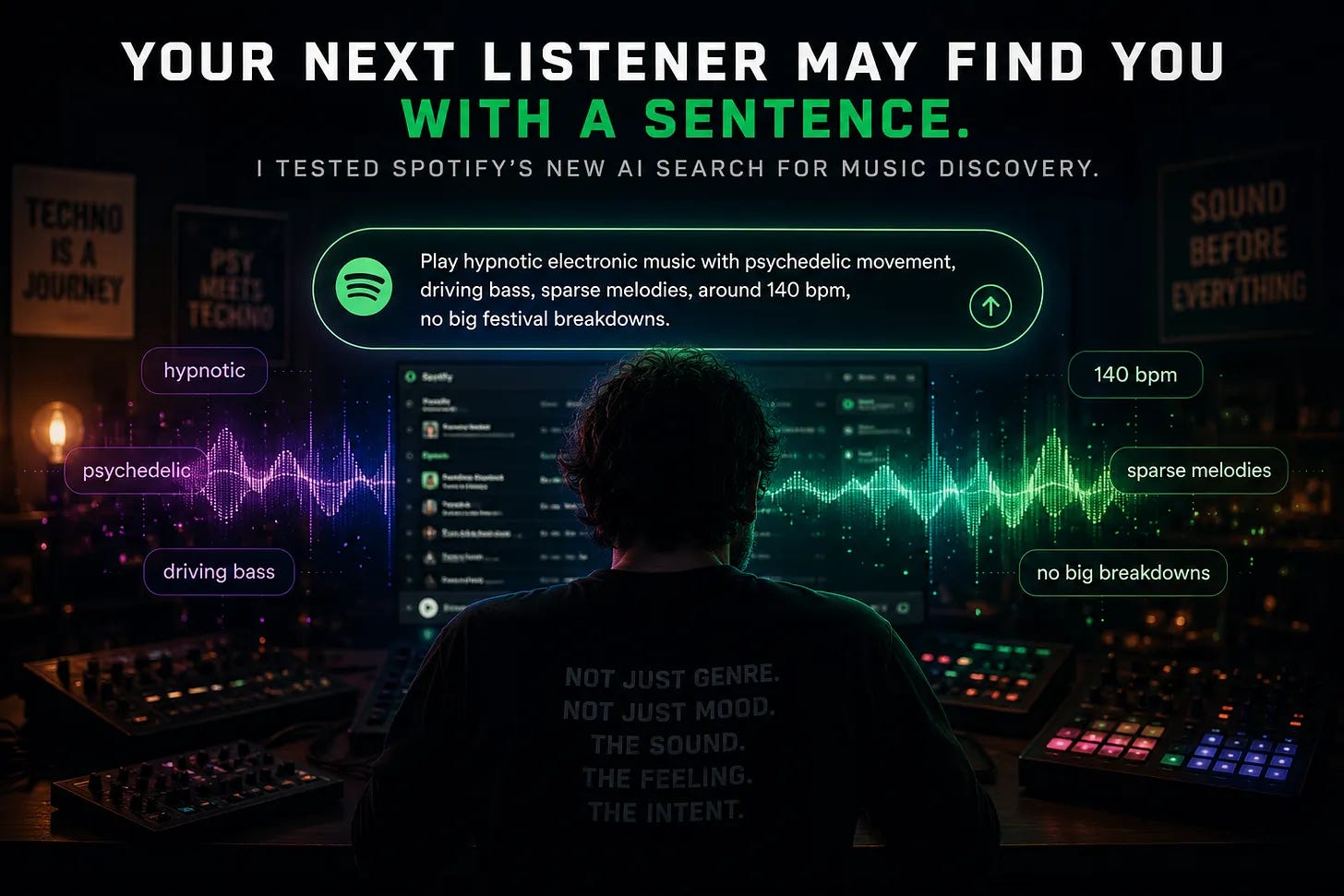
There’s a particular kind of track that’s annoying to describe. It has enough psychedelic movement that calling it techno feels incomplete, but enough restraint that psytrance doesn’t quite describe it either. Then an upload form asks for a genre and something complicated becomes a dropdown choice.
Genres are useful. DJs need crates, stores need organization and listeners need somewhere to start. But the label is still an approximation. Spotify just gave me another way to ask for the music: a sentence.
The beta was sitting right there
Spotify announced Talk to Spotify on July 14, 2026. It’s rolling out gradually in English to Premium listeners 18 and older in the U.S., Ireland and Sweden on iOS and Android. Listeners with access can type or speak from Home or Now Playing, then refine what they hear with follow-up requests.
In my app, it appeared on Home as a field that says “Ask for some music.”

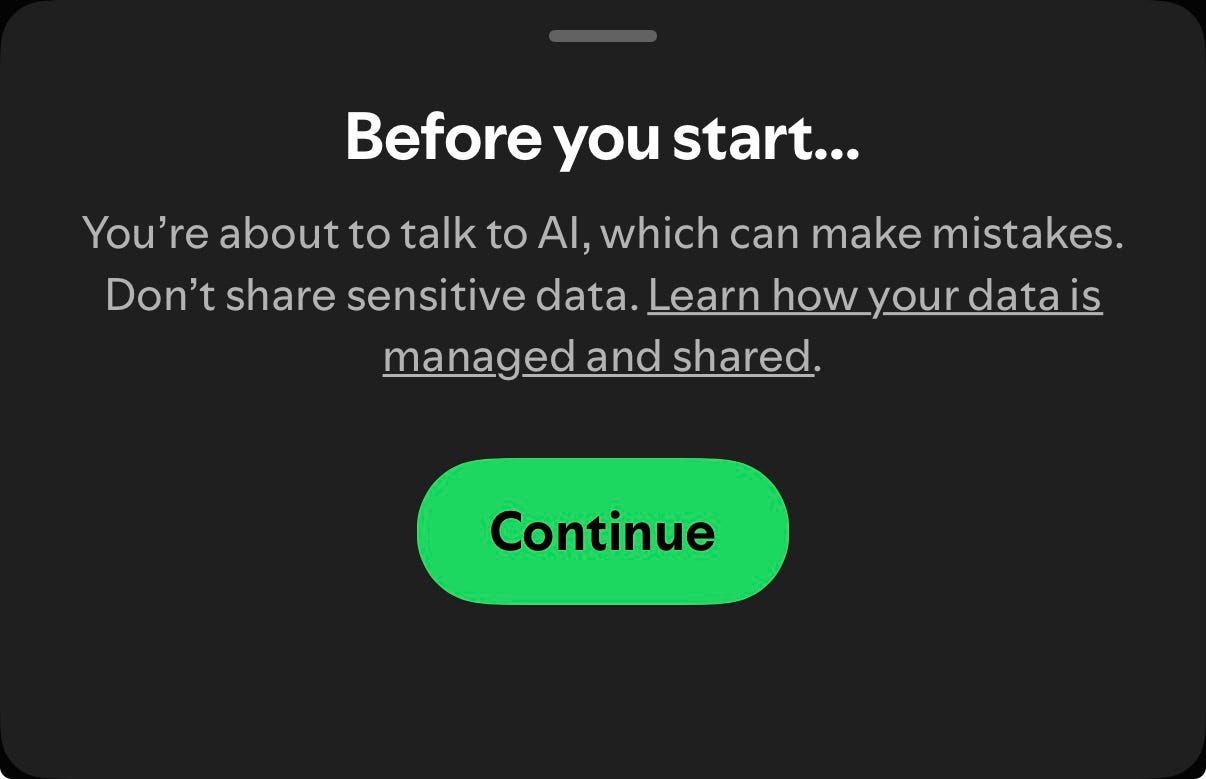
Tap it and Spotify puts the caveat right up front: you’re about to talk to AI, it can make mistakes and you shouldn’t share sensitive data.
Spotify explains what the interface can do, but not how every descriptive word gets mapped to a recording. I can test the input and inspect the output. I can’t see most of the machinery between them.
The easy words worked
I started with “Play hypnotic techno around 140 BPM.” Spotify opened with Yan Cook’s “Worm”, which Beatport lists as Techno (Peak Time / Driving) at 138 BPM. Pretty close on the parts I could verify.
Then I added “with psychedelic movement” and got Amotik’s “Ikat.” My third prompt asked for “fast, hypnotic electronic music around 140 BPM with psychedelic movement, driving bass and very little melodic content.” Spotify led with Yan Cook’s “Blades”, which Beatport lists at exactly 140 BPM under Techno (Raw / Deep / Hypnotic).
That isn’t proof Spotify understood every adjective. Tempo and established genre language are easier to verify from the outside than “psychedelic movement.” The early results still made enough sense that I kept pushing.
Then I took away the labels
The test I cared about most removed techno, psytrance and Psy-Techno entirely. I asked for “fast electronic music with driving low end, psychedelic modulation, sparse melodic information, hypnotic repetition and long tension without giant festival-style releases.”
Spotify opened with Big Wild’s “Strangeland.” Beatport lists it as House at 140 BPM. Farther down the queue were Galantis and Ian Asher’s “Runaway (U & I)” and Ian Asher with Olly Alexander’s “Desire,” which sounded like a pretty different neighborhood from the one I thought I’d described.
Beatport’s categories aren’t a final truth about sound, but they’re useful here as an external reference. In this run, the tempo neighborhood survived while the aesthetic neighborhood became much harder for me to recognize.
Psy-Techno didn’t rescue it
Beatport introduced Psy-Techno under Techno (Peak Time / Driving) on January 27, 2026, describing it as a crossover between techno’s hypnotic pulse and psychedelic sound design, driving basslines and Psy-Trance-style layering.
So I added: “Something in the Psy-Techno area.” Spotify renamed the request “Psy-techno music request” and opened with Aaron Hibell’s “destroyer of worlds”. Beatport lists it as Dance / Pop at 83 BPM. One track doesn’t settle anything. Still, the label I expected to help didn’t move the first result where I expected it to go.
The conversation itself also hit a beta edge. “Keep the psychedelic movement, but less psytrance and less hard techno” returned “Something went wrong. Please try again.” I retried five times, then “Make it more hypnotic” failed too. Starting a new conversation fixed it for me. I don’t know what broke.
Then I said ZenOne
For the last test I gave Spotify an artist anchor: “how about songs by artists like ZenOne. then play artists I probably haven’t heard before that fit this sound.”
Spotify answered: “Going ZenOne-adjacent and keeping it new-to-you. Same psy-techno tension, just more unfamiliar artists.” The first result was Gary Beck’s “Ghost”, which Beatport lists at 140 BPM as Techno (Raw / Deep / Hypnotic). Next came DJ Dextro’s “1000 Places”, also 140 BPM in the same category.
That was noticeably closer to the territory I expected. And yes, my first reaction was still: damn, where’s ZenOne? Then I reread my prompt. I’d asked for artists like ZenOne and for artists I probably hadn’t heard before. Not playing ZenOne itself was reasonable.
In this one personalized session, my descriptor-only prompt wandered away from the neighborhood I had in mind. Adding ZenOne produced first results that Beatport categorizes as Raw / Deep / Hypnotic Techno at 140 BPM. I can’t tell you why Spotify made those choices. Its public explanation doesn’t expose enough of the recommendation process for me to pretend otherwise.
A sentence is another handle
I started with the idea that conversational discovery might make a producer’s sonic fingerprint easier to find. After using it, that feels too clean. Spotify handled some explicit constraints well in my session, then became much less convincing to me as I shifted toward compound descriptions of movement, restraint and tension.
My read after one session is that natural language works better as another steering layer than as a replacement for genre or artist relationships. Beatport is making one crossover taxonomy more precise while Spotify lets listeners say more than the taxonomy can hold.
There’s a producer experiment in that gap: describe one of your tracks without the artist name or genre. Use pace, density, movement, tension, space and whatever slightly strange words you’d use with another producer. Put that sentence into Spotify, then run it again with your artist name as the anchor. Compare where each one goes.
What happens when you describe your most recognizably you track without giving Spotify the genre or artist name?
Sources & Further Reading
Spotify. “Just Say the Word: A More Personal Way to Ask, Discover, and Listen.” July 14, 2026. https://newsroom.spotify.com/2026-07-14/talk-to-spotify-announcement-beta/
Spotify Support. “Talk to Spotify to discover and shape your listening.” https://support.spotify.com/us/article/talk-to-spotify/
Spotify. “Prompted Playlist in Beta Coming to Premium Listeners in More Markets.” January 22, 2026. https://newsroom.spotify.com/2026-01-22/prompted-playlists-expansion/
Spotify. “Spotify’s Discovery-Driven Playlists Keep Your Weekly Music Rotation Feeling Fresh.” July 10, 2026. https://newsroom.spotify.com/2026-07-10/discovery-playlists-release-radar-control-updates/
Beatport. “Beatport Launches New Sub-Genre: Psy-Techno.” January 27, 2026. https://www.beatportal.com/articles/1257068-beatport-launches-new-sub-genre-psy-techno