

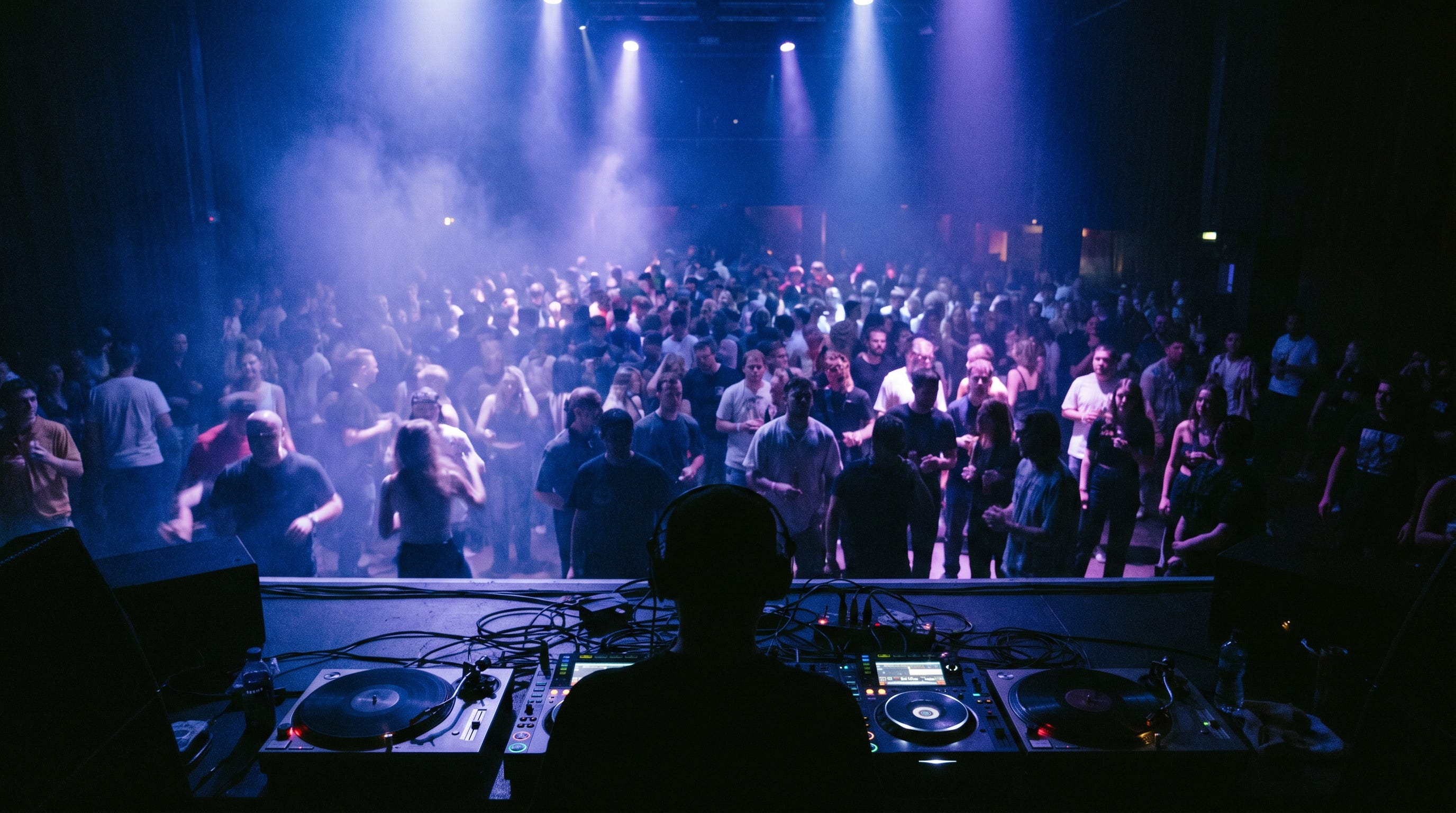
You’re at minute 90 of a four-hour set. The floor has been moving for an hour. The DJ is still doing everything right: tempo locked, transitions clean, energy sustained.
The room isn’t responding the same way it was at minute 30.
Not inattentive in the phone-checking way. Something subtler. The kick lands and the floor absorbs it. Nothing comes back. That’s not fatigue from effort. That’s the brain running a pattern it already knows. When it knows what’s coming, it stops paying forward.
The Energy Myth
Most producers finishing a track for DJ use assume the same thing: if it’s energetic enough, it will land. Build the drop harder. Push the sub. Drive the bassline. Energy is the currency of a DJ set.
Energy maintains a floor. Novelty moves it.
Neural engagement with repeated musical patterns drops as the brain learns to anticipate what comes next. The effect isn’t gradual. It’s a cliff. At some point, more intensity doesn’t produce more response. It produces less, because the brain has already modeled what comes next and is no longer firing in recognition of the unexpected.
You’ve felt this in a room without knowing what you were feeling. The floor peaks. It plateaus. More tracks come in with the same rhythm profile, the same harmonic texture, the same drop weight. The response stops scaling with the intensity. The DJ isn’t losing the room. The production window closed.
That ceiling isn’t volume. It’s anticipation.
What Novelty Actually Is
Novelty in a set isn’t a genre switch or a BPM jump. It’s a production character change.
Think of it like a film that uses the same camera angle for 40 minutes. Nothing is technically wrong with any individual shot. The eye adjusts, then goes numb. Then a cut changes the angle and the scene suddenly has depth again, not because the story changed, but because the visual grammar shifted.
A set works the same way. What shifts the grammar isn’t energy level. It’s the production character of what enters the mix.
The pad texture that hasn’t appeared in this set before. A kick with a different transient shape than the last five. A harmonic layer occupying a frequency range nothing has touched in 20 minutes. A decay length that doesn’t share its profile with everything surrounding it.
The listener’s brain can’t articulate what changed. It feels the shift. Attention reinstates.
That reinstatement is the floor “waking up” between tracks: the moment when something lands differently than expected and the room gives something back before it should. The DJ’s crossfader didn’t do it. Your oscillator choices from three months ago did.
The Window
Listen to a recorded four-hour set with this specific attention: not the transitions, not the track selection, not the BPM arc. Listen for when the production character shifts. New textural layer. Different harmonic posture. A rhythm profile that changes before the drop arrives. A sub relationship that doesn’t match the previous three kicks.
Mark each shift. Count the tracks between them.
The window runs somewhere between five and eight tracks before something in the production vocabulary of the set changes, or the floor stops giving back what it’s being asked to feel. That’s not a law. It’s an observation from repeated listening to sets that hold floors and sets that lose them. But it’s consistent enough that experienced DJs and producers feel it without being able to name it.
When the character shift arrives, the room wakes up. Not because it got louder. Because the sonic vocabulary became unpredictable again.
Your Production as Set Inventory
Every finished production is one unit of set inventory. It contributes a specific texture, harmonic posture and rhythm profile to whatever window it occupies in a set.
The problem: you can’t control the window.
A DJ might play your track after four cuts with a nearly identical pad texture and a similar kick weight. In isolation, your production is distinctive. In that window, it’s continuation rather than character shift. The floor’s response tells you which context it’s in. You weren’t there for the decision.
What you can do: produce for distinctiveness that survives context.
The elements that hold their ground in a window of similar productions sit in distinctly different places. A lead synth claiming a frequency range nothing else in your genre commonly uses. A rhythmic subdivision that doesn’t share its pattern with the standard 16th-note loop. A textural layer in the sub-mid (around 150-250 Hz) that creates a body resonance the surrounding tracks don’t have. A decay that’s half the length of what preceded it, or twice as long, creating time contrast where the ear expects continuation.
These aren’t accidental. They’re production decisions made in the session when you stop asking “does this sound good?” and start asking “does this sound different from what’s most likely to surround it?”
The Listening Experiment
Pull a recorded four-hour set you didn’t produce. Three to four hours is better than one.
Don’t listen for mixing technique. Listen for production character shifts: the moments where the sonic vocabulary changes. Mark each one.
Now count the tracks between marks.
You’ll see the window. Sometimes five songs. Sometimes eight. Rarely more than ten before the next character shift arrives. The DJs who hold floors across four hours aren’t only technically skilled. They’re moving through a novelty schedule, consciously or not, because the best track selection instinctively finds it.
Now pull your last finished production. Mentally surround it with five tracks most likely to precede it in a set from your genre. Does your production read as a character shift or as continuation?
That’s the right question. Not “is this good?” The floor at minute 90 doesn’t answer that question the same way your monitors do.
Capstone
Recently we started with a single reframe: a set isn’t a long song. It’s a different compositional form with different production rules. A track in a set isn’t a standalone statement; it’s a movable element in a larger narrative.
From there, every subsequent article addressed a different dimension of that narrative. The key you choose determines what harmonic conversations are possible downstream. The breakdown density you build determines how much tension can accumulate before the drop. The mix you deliver will be rewritten by every room it plays in, and anticipating that rewrite is part of the production job.
And now: the production you contribute is one unit of set inventory, and its job isn’t just to sound good in isolation. Its job is to shift the production character of the window it enters.
You’re not making standalone tracks. You’re building elements for a narrative arc you don’t fully control. The session is where you decide how much weight your contribution carries when the context is someone else’s.
Your production is set inventory. Account for what’s already playing.
What’s the one sound in your current production that no other track in your genre regularly has? If you can’t name it, the floor at minute 90 won’t feel it either.